Photo Review Reviews section

Panasonic Lumix DMC-TZ3

8 Rating

A very compact, extended-zoom digicam that would be an excellent choice for travellers.Panasonic has released two updates to last year’s DMC-TZ1 model, which we reviewed in June 2006: the 6-megapixel DMC-TZ2 and the 7.2-megapixel DMC-TZ3 (which is reviewed here). Both have the same 10x optical zoom lens, which covers a focal length range equivalent to 28-280mm in 35mm format but the TZ1’s 2.5-inch LCD monitor has been replaced in the TZ3 by a 3.0-inch display that fills three quarters of the back panel. No viewfinder is provided.

Panasonic Lumix DMC-TZ1

8.5 Rating

Compact and 10x zoom makes the TZ1 a good choice for travellers.Claimed as the smallest 10x zoom digital camera on the market, Panasonic’s 5-megapixel DMC-TZ1 recently received the T.I.P.A. Award for the best ‘Superzoom’ digital camera in Europe. Among the reasons cited for the win are the camera’s Optical Image Stabiliser (which is found in all Panasonic digicams) and the new Venus Engine III processor. The ‘unlimited’ burst mode, which lets users fire off a burst of shots at half-second intervals until the memory is full, also got a Guernsey, as did the integrated retractable lens system with its folded optics technology.

Panasonic Lumix DMC-LX-1

Panasonic’s new Lumix DMC-LX1 camera is unique in having a CCD sensor that delivers its full 8.4-megapixel resolution for shots taken with a 16:9 aspect ratio. Designed to produce shots for display on the latest ‘widescreen’ TV sets and monitors, the LX1 has a slider on the lens barrel that lets users set the capture aspect ratio to 3:2 or conventional 4:3.

Olympus Mju 720SW

8.5 Rating

An affordable, high resolution digicam that’s waterproof and shock-resistant and includes 25 scene presets.With a slimline stainless steel and aluminium body the new 7.1-megapixel Olympus ø‚ µ 720SW has rubberised gel sealing and shockproofing around the lens, circuit board, battery/card slot and USB port. Waterproof to three metres and withstanding a 1.5 metre drop, the 720SW deserves its “Tough” tag. It’s available in silver or Polar Blue and sports a 3x optical zoom lens and 2.5-inch LCD but no viewfinder.

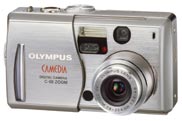
Olympus Camedia C-60

The quality of both still shots and movie clips was unexceptional. Many JPEG images lacked sharpness and colours, though accurate, were somewhat saturated. The exposure system was patchy and outdoor shots were rather contrasty. Flash performance was adequate but low-light shots had visible noise and some stuck pixels. The C-60’s response times were average, although it took around five seconds to start up, which is pretty slow. Capture lag was consistent at 0.7 seconds, with shutter lag averaging 0.2 seconds.

Olympus Camedia C-760 Ultra Zoom

On test, the C-760 delivered images that were clear, with accurate colour but slightly boosted saturation and contrast. Metering favoured shadows over highlights. No fringing was detected in backlit shots. Stuck pixels were abundant in exposures over five seconds. White balance performance was good, except with incandescent lighting. Response times were below average.

Nikon Coolpix P1

Nikon’s 8-megapixel Coolpix P1 and similarly-featured 5.1-megapixel Coolpix P2, along with Kodak’s EasyShare-One, are the first Wi-Fi cameras to go on sale in Australia. With the growing popularity of home wi-fi networks, the concept looks appealing: a camera that can be wirelessly connected to your computer from anywhere in your home. However, making it happen isn’t as easy as you might think!

Konica Minolta DiMAGE Z6

Konica Minolta’s DiMAGE Z6 is almost identical in design to the Z3 and Z5 models but sports a higher-resolution, 6-megapixel sensor. The 12x optical zoom lens has the same specifications and focusing range and the control layout is identical, so the problems we identified with the SD card slot in the base of the Z3’s body remain unsolved in the Z6; it is still too easy to open inadvertently.

Kodak EasyShare DX7630

Kodak’s EasyShare DX 7630 has features to attract photo enthusiasts but presents them in a way that is targeted more at point-and-shoot photographers. The camera’s 6-megapixel sensor is impressive and its plastic body is well-built and thoughtfully designed. User-adjustable controls include P, A, S and M shooting modes, exposure and flash adjustments, ISO settings, 16 scene pre-sets, and a custom mode that lets you save ‘user-created’ selections.

Casio Exilim EX-Z110

Casio’s new 6-megapixel Exilim EX-Z110 is a surprisingly versatile little camera, with features to attract both novices and more experienced photographers. The former will find the proprietary ‘Anti Shake DSP’ processing, which works by combining a fast shutter speed with post-capture processing and reduces blurring due to camera or subject movement, handy. However, it’s only available in full-auto mode and doesn’t work for shooting movie clips.