Photo Review Reviews section

Casio EX-Z50

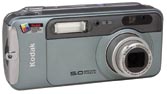
The EX-Z50 is the cheaper of Casio’s new 5-megapixel Exilim models. It’s also slightly smaller and lighter and has a smaller LCD display but, otherwise the only differences between it and the EX-Z55 are slightly lower power efficiency and a different control layout. With so little between these two models, it’s difficult to see why you might choose the Z50 over the $50 dearer Z55, although the Z50 is slightly lighter. The viewfinder is tiny and poorly positioned – but it’s better than having none at all. The rear panel sports two handy Direct On buttons, which start the camera in either capture or playback mode. Users can customise the left/right keys on the four-way controller to access functions like the recording mode, EV shift, white balance, ISO or self-timer – but it’s easy to change settings inadvertently.

Casio EX-S100

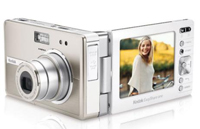
The first camera with a transparent ceramic lens, Casio’s Exilim EX-S100 is one of the slimmest and most compact digicams we’ve seen. Weighing less than 120 grams with its slender lithium-ion battery loaded in its smart stainless steel body, the S100 is a beautifully constructed unit for anyone who wants an ultra-portable camera.Some of the control buttons are very small, but;the controls are well designed and include functions that make the camera easy to use, such as Direct On buttons for capture and playback, 23 Best Shot settings, Icon Help and Business Shot.

Casio Exilim EX-Z1000

8.5 Rating

Ultra-high resolution presents technical challenges to a prestige point-and-shoot camera with some interesting and useful functions. We can’t understand why Casio put a 10-megapixel imager into its new slimline digicam, the EX-Z1000. By our calculations, each photosite on this chip has an area of just under two microns square. This will challenge the on-board image processor and is likely to produce a narrower dynamic range and more image noise than lower-resolution models. By comparison, the photosites on Sony’s DSC-R1 or Nikon’s D200 models are much larger at just over 6.8 microns square.

Canon PowerShot Digital Ixus IIs

Canon’s Digital Ixus IIs is a minor update to the successful Ixus II but sports a slick ‘Silver White Finish’ to its stainless-steel body and a new Print/Share button and direct printing enablement. It’s a pity Canon didn’t put a 4-megapixel sensor in this model when they added the Print/Share button since, small size and attractive design notwithstanding, $549 for a 3.2-megapixel, 2x optical zoom camera is a big ask in the current marketplace!

Canon Digital Ixus 700

[ia] Rounded contours and a larger, 7.1 megapixel sensor characterise Canon’s new Digital Ixus 700. Featuring the latest DiG!C II image processor, it sports a generous control suite for a point-and-shoot camera. The rear panel mode dial has settings for playback, auto, manual, scene and movie capture. In auto, the only functions you can change are resolution and quality – plus settings accessed via the arrow buttons. Manual lets you set exposure compensation, white balance, ISO and photo effects. The scene mode calls up nine scene mode and the movie clips can be recorded at VGA or QVGA resolution with frame rates of 30 or 15 fps or QQVGA clips at 15 fps. A special ‘Fast Frame Rate’ setting records QVGA clips at 60 fps.

HP Photosmart 8750

HP’s Photosmart 8750 inkjet printer is the most affordable A3 printer on the market that produces long-lasting, prints that are good enough to exhibit or sell. Initially, its sheer size is daunting, although its weight is similar to the Epson R2400. However, you can’t fairly compare these two printers as the Epson is twice the price of the HP model. Not surprisingly, the 8750 is slightly noisier and we had more problems with paper jams and incorrect loading.

Epson Stylus Photo RX530

9 Rating

Promoted as a ‘total photo solution for home users’, Epson’s Stylus Photo RX530 supports direct printing from PictBridge enabled cameras and most popular memory cards as well as computer-based printing from editing software. It also sports a high-resolution flatbed/film scanner that doubles as a copier for both photos and documents. Stand-alone users can scan, copy and print with one-touch simplicity and the bundled software provides easy integration with image and document editors and email utilities when the RX530 is connected to a PC.

HP Photosmart 475

8.5 Rating

A compact, portable printer that is easy to use and produces long-lasting snapshot-sized prints.Despite its resemblance to a pop-up toaster, HP’s Photosmart 475 printer is a surprisingly capable and versatile device. Lift the handle and you can take it anywhere. Plug it in, switch it on and it’s ready to print. Connect it to a TV set via the supplied video cable and you can watch a slideshow of images stored on the 1.5 GB internal hard disk drive or a memory card from your camera (all popular cards are supported). A remote control lets you drive the slideshow from your armchair.

Epson Stylus CX4700

8.5 Rating

Epson’s Stylus CX4700 is an affordable multifunction printer for home and small office users who want top quality document printouts plus scanning and copying facilities and the ability to print photos. It uses four individually packed DURABrite Ultra pigment inks, which promise prints that will last up to 120 years and offers an ‘optimized’ resolution of 5760dpi with Resolution Performance Management (RPM) technology.

Epson Stylus Photo R2400

9 Rating

The first desktop printer with Epson’s new UltraChrome K3 ink set, the Stylus Photo R2400 produces long-lasting, exhibition-quality colour and monochrome prints. This latest set of pigment inks delivering much richer colours and a wider colour gamut than Epson’s previous ink sets and can match – and on some papers, better – the performance of printers with top-quality dye inks.