
Owners of EOS 5D Mark II cameras can now download the new firmware that enhances the camera’s movie functions from Canon Australia’s website.

Canon EOS 30D
Plenty of worthwhile refinements to a popular semi-pro DSLR.While many observers expected a sensor upgrade when Canon announced this year’s first new DSLR, the new EOS 30D sticks with the EOS 20D’s 8.2-megapixel CMOS chip, while offering some noteworthy improvements over its predecessor. The camera body has been re-designed to accommodate the same 2.5-inch, 230,000-pixel rear LCD monitor as the EOS 5D and, although this makes the 30D slightly larger and heavier, it provides a bigger, better display with a much wider viewing angle.
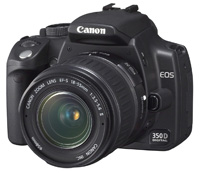
Canon EOS 350D
Unlike the EOS 300D, Canon’s new EOS 350D is in no way firmware-disabled. The company has thereby addressed many of the issues that made its predecessor, the EOS 300D recipient of almost universal criticism and brought to market a DSLR that is in most respects, as function-rich and capable as the more expensive EOS 20D. Plastic body notwithstanding, the new model is better built yet 25% smaller and 15% lighter than the 300D, thanks largely to a smaller battery. It also starts almost instantaneously and flash output is now adjustable across +/- 2 stops in 0.3 stop increments. Initially released in the same ‘silver’ colour as its predecessor, by the time this review is published a black version will also be available for the same price.
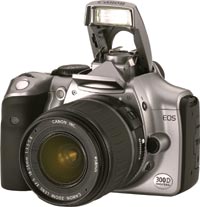
Canon EOS 300D.
The first under-$2000 DSLR on the market is still a landmark camera and continues to attract buyers. Its plastic body is sturdy – but reasonably light, thanks to the use of a pentamirror instead of a glass pentaprism.
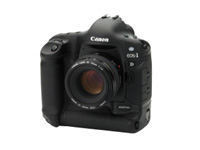
Photokina Report – Day 1: EOS-1Ds New Canon SLR
One of the most exciting announcements on the first day of Photokina has been Canon’s new digital SLR which features a CMOS sensor that has the same area as a 35mm film frame.
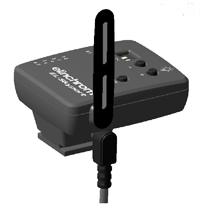
Elinchrom’s new Remote Flash Triggers
Elinchrom has released a new ‘Skyport’ flash trigger system that provides both flash triggering and the wireless remote control of all RX flash unit functions for studio lighting systems.

Sony Cyber-shot DSC-W1
A smart metal body and large LCD screen combine with a high-resolution sensor to make Sony’s DSCW1 Cyber-shot an attractive camera, and its competitive price and ease of use will contribute to its success. So, too, will the Carl Zeiss Vario-Tessar lens, although its wide-angle coverage may not be ideal for all photographers. It’s hard to fault the W1’s overall design as all controls and fittings are well placed and easy to use. The W1 mixes point-and-shoot functions with controls to appeal to serious photographers.
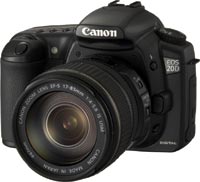
Canon EOS 20D.
Canon’s 8-megapixel replacement for the ESO 10D has a solid feel and many of the features of the professional EOS-1D.
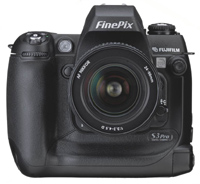
End-of-Year Release for Fujifilm FinePix S3 Pro
Fujifilm has announced that its long-awaited FinePix S3 Pro digital SLR camera is likely to be released worldwide in late October.

Elinchrom’s Lightweight Ranger Quadra AS Flash
Kayell Australia will receive stock of Elinchrom’s new Ranger Quadra AS portable battery powered flash this month.