The transition from snapping high school mates to being a sports photographer at the highest level has been a dream run for Ryan Pierse.
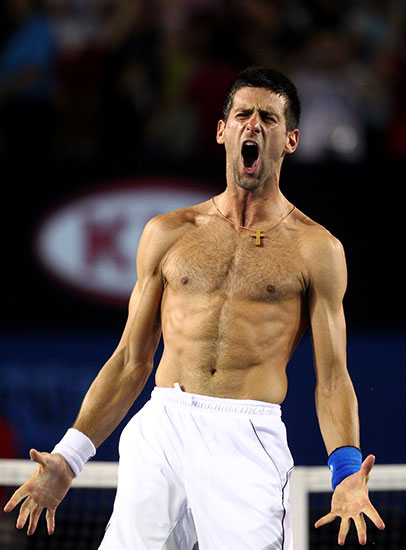
During day fourteen of the 2012 Australian Open at Melbourne Park on 29 January, 2012 in Melbourne, Australia.
As a senior sports photographer for Getty Images, Sydney-based Ryan Pierse is well used to dealing with the envy of his friends. ‘They say to me, “You get to go to all these big events and watch from the front row, or virtually on the pitch or the court or whatever.” I do, but it’s very different from being a spectator,’ he says.
For one thing, he can’t get emotionally involved in the moment or celebrate what happens. He has to keep his mind on the job and think about his next photo. At the same time, with technology and media competition being what they are these days, he has to download his photos to his laptop, crop and caption them, and send them off so picture editors all over the world have access to them within a few minutes of the action occurring.
For another thing, much of the time he doesn’t actually get to see the critical moments as they occur. He’s looking through a lens with the shutter up. ‘I wouldn’t say my memory of any event is a blur,’ he says, ‘but I remember the best pictures that came from them rather than the event itself.’
Still, he doesn’t take his enviable position for granted. He has always had a passion for sport, always wanted to be involved at the top level, “and if it wasn’t going to be as a player, then the media is the second-best thing.”
And if it’s going to be the media, it doesn’t get much better than Getty Images, the world’s leading visual communications company, headquartered in Seattle, Washington, with offices around the world. If it’s big in sport, a Getty Images team will be there. Pierse has worked at two summer Olympics and a winter Olympics, two Commonwealth Games, an Asian Games, two football World Cups, a Rugby World Cup, 15 Grand Slam tennis tournaments, 15 Formula One Grand Prix… He has also been exclusively selected to shoot assignments for clients including Nike Global, the International Olympic Committee, FIFA, UEFA, the Laureus World Sport Awards, HBO television and Adidas Europe.
Since going on the 2013 Ashes tour to England, he has spent 80 per cent of his time photographing cricket. Which is fine with him, because he loves cricket (see boxed story).
Pierse is a self-taught photographer who got his start by taking pictures of his high school mates playing sport at lunchtime and on weekends. His first camera was his dad’s Nikon F50.
‘I stole it from him when I was about 15 and he never saw it again,’ he says. ‘My first sports lens was a Tamron 200-400mm f/5.6 zoom, which was good for what I needed at the time. Looking back, I’m glad I had an upbringing with basic manual focus, single-shot film cameras because, to an extent, the equipment these days does everything for you.’
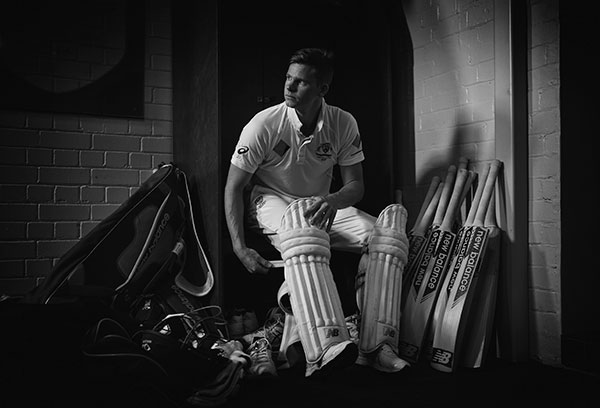
Steve Smith of Australia poses during a portrait session at Sydney Cricket Ground on 5 January, 2015.
By Year 12 Pierse was covering Aussie Rules, soccer, cricket and other sports for the local newspaper in the Essendon-Moonee Ponds area of Melbourne. He also developed and honed his skills by shooting ‘weird things’ such as adverts for car yards, Cash Converters and the like.
He says he learnt by making mistakes, plus picking up tips when working alongside experienced pros from the Herald Sun and The Age newspapers. ‘I used to learn something new every day, and I still do. I still enjoy making mistakes and learning from them.’
In 1999, when he was 19, he started working for the Essendon Football Club, covering all its games. As a massive Essendon fan, he thought he already had his dream job.
Around that time he started freelancing for Getty Images and after 18 months was offered a full-time job. ‘That first approach was a bit daunting. They like to throw people in at the deep end, and they showed a lot of faith in me. Within a year or two, Getty Images gave me the opportunity to work from the United Kingdom office for four years, covering major sport in Europe. It was a completely different, supercompetitive way of working, with five or 10 times the number of photographers at any event.’
If you’ve ever wondered what it’s like to be in one of those shoulder-to-shoulder clusters of photographers at a sports event, well, Pierse reveals that it’s ‘a strange little culture of its own’. You have your close mates and the colleagues you travel with, he says. ‘But on the whole, you’re in a pit with people you know by saying hello to them as you pass in the corridor. It’s quite weird working in such a close environment on that basis, and it’s very competitive. Everyone has their friends, but… there are people who aren’t so friendly as well.’
Pierse takes every opportunity to break away from the pack and look for a different shot, and being in a Getty Images team increases those opportunities. When a team is covering a lengthy event such as a cricket test or tennis tournament, it works to a daily roster that shares the shooting positions around. ‘It’s something that sets Getty Images apart,’ he says. ‘We can go to the less obvious positions, take a chance, and you sometimes get that one shot everyone’s looking for. And it also happens to be an exclusive.’
A case in point was a shot he got at the Australian Open in 2012. Novak Djokovic and Rafael Nadal battled it out in the final for more than five hours, and all that time he was the only photographer sitting behind thick glass at the back of the court where the TV commentators sit. ‘When Djokovic won match point, he turned and was effectively looking straight at me when he tore off his shirt. The 100 or so photographers in the main pit basically got shots of the back of his head.’
Another stunning, unexpected moment was when Usain Bolt took off his shoe and kissed it after winning the 100 metres at the 2008 Olympics. ‘The angle and light were perfect for me. The shoe even had “Beijing 100m final” written on it.’ Pierse got a Highly Commended for that one at the Pictures of the Year International.
The award that has meant the most to him was a third place in the World Press Photo gongs in 2006. ‘Okay, so it was only a third. But it was my first major placing, with World Press Photo probably being regarded as the pinnacle in terms of editorial sports photography.’ The shot showed Andy Roddick playing out of the shadows at the Australian Open, and it was more artistic than significant in a news sense.
‘Obviously, the bread and butter is getting the moment – getting the wicket, getting the gold, getting the celebration. That’s what most of our clients want and need. But most of our photographers shoot with an artistic eye as well. We’ll stand in spots that might not necessarily be the best for capturing a significant moment, but there’s a patch of light, or something happening in the background, or we’ll use a slower shutter speed, and we’ll work on that picture idea for a while. A lot of these pictures might never get used, but the option’s there for the client.’
Getty Images has five photographers on staff in Australia, plus more than 40 freelancers it works with, and staff who manage the photographers and assignments.
‘We’re in a good position in that Getty Images is the official photographer for a lot of sporting bodies and events,’ says Pierse. ‘We’re not given preferential treatment, but we’re allowed to shoot what we need to shoot and be in the positions we need to be in to get the best pictures.’
Shooting portraits of sportspeople largely depends on the relationships the photographers have with the players, coaches and sporting bodies. ‘If they trust you, you can get some good access. You have to work on it because a lot of athletes won’t give up their time that easily. You have to pitch it the right way and have an interesting concept for the shoot. It can be quite “out there” sometimes, but that gets the subject interested, rather than just another studio shoot.’
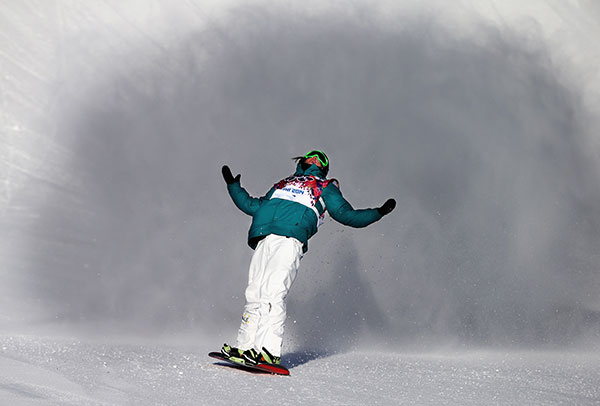
During the semi final of the Snowboard Slopestyle at Rosa Khutor Extreme Park on 8 February, 2014 in Sochi, Russia.
Getting all the gear to an event in special transport cases is quite a production sometimes. When they go to big events like the Olympics, Commonwealth Games or World Cup, they don’t leave anything at home. ‘A lot of the time we don’t know which sport we’ll be shooting on any particular day, so we have to be prepared for every situation.’
Pierse says he rarely gets stressed on the job. ‘You never get too relaxed either, but it becomes second nature after a while. Obviously you think about where you’re going to sit, and do the preparation. Then you have to let it flow. Let a lot of the pictures come to you rather than chase them too much.’
Clicking with cricket
Ryan Pierse is a self-confessed cricket nut who has followed the Australian team for as long as he can remember. But ‘following’ took on a whole new meaning in 2013 when Getty Images assigned him to photograph the Ashes tour to England.
Since then, he has accompanied the team all over Australia, to the United Arab Emirates several times and wherever else it has played. At time of writing, Getty Images had just been appointed the official photographer for Cricket Australia and he was entrenched in its World Cup campaign, and relishing the prospect of tours of the West Indies and back to England again for the Ashes.
‘It’s a lot of time on the road, but it’s a unique situation,’ he says. ‘Many of the players bring their wives or partners and children on tour, so it’s like having a big family to travel with. They’re quite accepting and trusting, and make me feel part of the whole experience. The spirit and cohesion in the team is something special. I’m not worried about the extra hours I work. Some of my friends think I’m crazy, but I guess you either love cricket or you hate it.’
A typical day of shooting begins with arriving at the ground about 90 minutes before the start of play to set up the gear. ‘There’s quite a lot of equipment. My main lens, a Canon 600mm f/4, is a big piece of kit. I’ll take three camera bodies to a test, plus a range of smaller lenses. On top of that, there’s remote gear, clamps, my laptop, wet-weather clothing.’
‘We’ll usually have one or two remote cameras high in the stands, looking down the wicket, more or less as a back-up. They’ll have a 70-200mm or 300mm, to provide an overview of the central wicket area, including the slips. We use Pocket Wizards to fire that camera at the same time as the camera at ground level.’ Shooting cricket is a game of patience and attrition, says Pierse. ‘It’s a long day, especially when it’s hot, sometimes for five days. You might not take a picture on every ball, but you have to be ready to. Go get a drink, or let something in the crowd distract you, and something’s sure to happen.’
Excerpt from Photo Review Issue 62