The 2026 CP+ International Camera and Photo Imaging Show closed yesterday without creating much excitement since, apart from a handful of lenses, no new production-level cameras were shown.
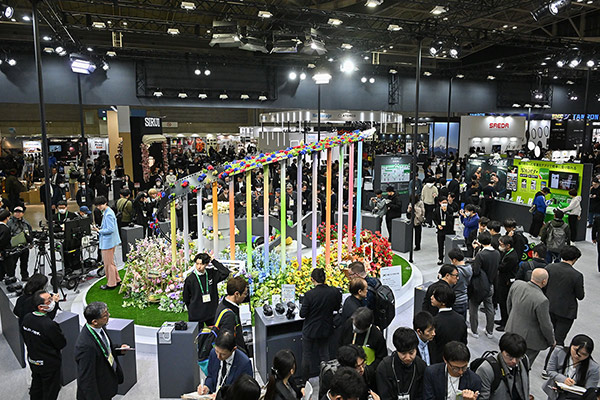
This view of the show floor gives an indication of the popularity of the event. (Source: CP+.)
CP+ 2026, which closed yesterday, was expected to surpass the 2025 attendance figures of approximately 56,000 on-site visitors and 420,000 online viewers due to a record-breaking number of exhibitors. This year, a record number of 149 companies and organisations participated and more than 23,000 visitors came to the site in its first two days. However, despite these impressive figures, for a major international imaging show it didn’t provide the excitement equipment buyers were seeking. All the major manufacturer released or announced their new cameras at least a month before the show opened. Even Nikon, which usually has something to talk about when the show opens, made its announcement of the new Nikkor Z 70-200mm f/ 2.8 VR S II lens five days before the show, while Tamron, unveiled its 35-100mm f/2.8 Di III VXD full-frame zoom lens for Sony E-mount and Nikon Z-mount cameras a week before the show opened.
Here’s a summary of the new products that were announced just before and on the opening day of the show;
Panasonic announced a new Lumix DMW-DMS1 all in-one microphone plus firmware updates for its full-frame mirrorless Lumix S1RII, S1II, S1IIE, S5II, and S5IIX cameras.
Sigma had four lens announcements with two new wide-angle primes – a 15mm f/1.4 lens for APS-C cameras and a 35mm f/1.4 prime for full frame cameras – and a Cine 28-105mm t/3 lens plus a development announcement and prototype on display for the 85mm f/1.2 Art lens (L and FE mounts).
Voigtlander displayed a 40mm ‘pancake’ lens that had been pre-announced earlier in the month, along with the 35mm f/1.4 Nokton for the Canon RF and Nikon Z mounts.
Zeiss announced the addition of the new Otus ML 1.4/35 lens to the existing 1.4/50 and 1.4/85 lenses, which are available for the Canon RF, Nikon Z, and Sony FE mounts.
Korean lens maker Samyang showcased five new zooms: the 14-24mm f/2.8 and 24-60mm f/2.8 for L-mount plus the 20-50mm f/2, 28-135mm f/2.8 and 60-180mm f/2.8 for Sony FE mount. It also showed prototypes for new 200mm f/1.8 and 300mm f/4 telephoto lenses.
Chinese manufacturer, Brightin Star, had a 35mm f/1.7 lens for Leica M on display as well as a new 50mm f/2 ‘Tri-Sight’ lens for Canon RF, L-mount, Nikon Z, and Sony FE, which features adjustable bokeh.
Also from China, 7Artisans officially released the AF 40mm f/2.5, an ultra-light (90 gram) prime lens for Sony E mount, which will be offered in L-mount and Z-mount at an unspecified future date. It also displayed an upcoming lens, the AF 135mm f/1.8 which will be offered for the L, Nikon Z, and Sony FE mounts.
Among the other exhibitors, Megadap released a new M2RF Adapter that allows manual focus Leica M lenses to be used with autofocus on Canon RF cameras and Canon showcased 3D Imaging technology that uses Dual Pixel architecture to generate 3D/VR data from standard lenses without specialized hardware. Canon also showed a prototype of a camera with a waist-level viewfinder and a ‘folded’ optical path. While interesting in appearance, it’s unlikely to become a ‘real’ product since it’s difficult to find reasons to buy it. Equally enigmatic was the Kenko Retro-Digi 90, a cheap digital camera designed to look and feel like a disposable film camera and requiring users to ‘wind frames on’ between shots.
The Ricoh booth at CP+ was entirely devoted to the Ricoh brand with no evidence of Pentax (which Ricoh owns). This isn’t surprising since the last Pentax DSLR camera was the K-3 Mark III Monochrome in 2023, which appears to have been discontinued. Finally, Atomos announced the 5-inch Ninja RAW monitor, which records Apple ProRes or ProRes RAW to CFexpress Type B or external USB-C storage.