

In summary
An imaging-focused smartphone with IP66, IP68 and IP69 dust and water resistance plus a Hasselblad-designed master camera system and 200-megapixel telephoto camera.
The Find X9 Pro is up there with the best image quality of the latest smartphones and does particularly well when recording video. It’s able to capture high-resolution stills in JPEG, HEIF and DNG.RAW formats (although not simultaneously) and also record 4K video at up to 120 fps. LOG support is available if needed.
Full review
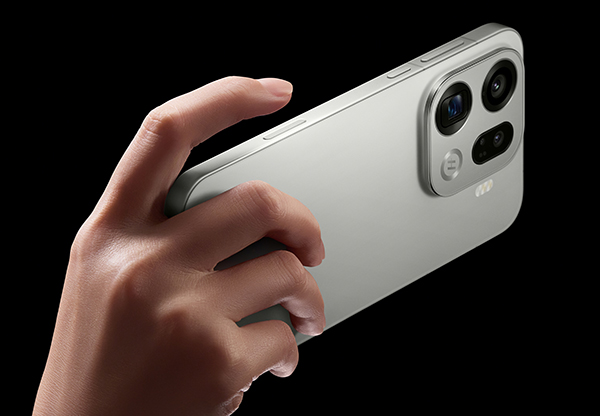
Launched worldwide in September 2025, the OPPO Find X9 Pro is a flagship smartphone with three front-facing cameras and a single ‘selfie’ camera that faces the user. It’s available in Silk White or Titanium Charcoal colours and began shipping in Australia on 15 January. Photo Review was offered a review opportunity five days later and, given the proliferation of imaging-capable phones in the past year or so, we felt the time had come. It’s our first review of a smartphone’s cameras so we’ll concentrate on the device’s imaging and video performance and outline the main imaging features. We won’t investigate any of the phone’s telecommunications facilities since we’re not experts in that area.
The OPPO Find X9 Pro Silk White version. (Source: OPPO.)
We received the review smartphone with the Hasselblad Teleconverter Kit, which is reviewed separately. The first thing we had to do was update the device’s firmware; a relatively simple process achieved by connecting to Wi-Fi and downloading Firmware update Color OS V number CPH2791_16.0.3.504. The new firmware took a couple of minutes to install and while it did, we checked the improvements it would make, which are as follows:
- You can now set a specific EV in Hasselblad Hi-Res mode;
- Improves colour performance under special light sources;
- Improves camera stability;
- Photos app now supports editing images at up to 50 MP without compromising image quality;
- Integrates Jan 2026 Android security patch;
- You can now search for files from folders in the Private Safe and share files in the Private Safe.
Who’s it for?
As a publication for photographers, we’ve been looking at the best ways to evaluate smartphones. Reviewing the OPPO Find X9 Pro has been a most interesting exercise and given us some worthwhile clues as to what to look for, what can be measured – and what can’t.
One thing we’ve learned is that while your phone is the camera you always have at hand, when it comes to meeting enthusiast photographers’ needs, it can’t compete with ‘proper’ cameras. There’s no proper viewfinder, you’re forced to use the screen for framing shots and adjusting controls – often simultaneously – which is frustrating when you’re used to working with a viewfinder and button plus menu controls.
Besides, the whole point of having a smartphone is communications: making and receiving calls and accessing the internet. Image capture will always be a secondary function; the sensors in your phone’s cameras are tiny, as are the lenses, because you can’t fit large sensors and lenses into a case that is less than 8 mm thick.
That said, smartphones have recently become interesting to photographers as a platform for developing new image processing technologies, many of which have been taken up by camera manufacturers. Just think of computational photography for HDR (high dynamic range) and focus/exposure stacking, AI-driven autofocus, scene recognition and noise reduction and always-on wireless connectivity.
Consequently, more people are using their smartphones for taking photos and recording video when they don’t want to carry a full camera kit. Most recent models can deliver good enough photos and videos for holiday travellers, provided they work within their limitations.
While a smartphone will usually be a secondary device for serious photographers, the Find X9 Pro provides enough imaging functions for those who want for a well-built, durable smartphone that can double as an imaging tool in most situations. Ideal for Android users, its environmental ratings make it especially suitable for travellers and bushwalkers who require a lightweight, compact imaging device that can be used outdoors.
When it comes to stills capture capabilities, the Find X9 Pro is up there with the best of the latest smartphones and does particularly well when recording video. It’s able to capture high-resolution stills in JPEG, HEIF and DNG.RAW formats (although not simultaneously) and also record 4K video at up to 120 fps. LOG support is available if needed.
Like many other smartphones, the Find X9 Pro offers a similar hi-res function to the hi-res modes on recent mirrorless cameras, based on multi-shot capture. A message pops up on the screen in this mode warning you to keep the camera steady.
The miniaturisation of components has made stabilisation difficult but the telephoto camera in the Find X9 Pro uses prism hybrid OIS with active optical alignment, backed up by digital stabilisation to counteract camera shake when recording video. Electronic stabilisation is used by the front ‘selfie’ camera. These features make it a ‘premium’ device.
Build and Ergonomics
Physically, the Find X9 Pro measures 76.46 x 161.26 mm and is 8.25 mm thick and weighs roughly 224 grams. It has a 6.78-inch (160.1 x 75.3 mm) Flexible AMOLED screen with a resolution of 2772 x 1272 pixels plus a 120Hz refresh rate and up to 3600 nits peak brightness. It is surrounded by ultra-thin (1.15mm wide) bezels and covered in Corning’s Gorilla Glass Victus 2 protective glass.
The Find X9 Pro boasts IP66, IP68, and IP69 water and dust resistance and has a large, 7500mAh battery that supports 80W SuperVOOC wired charging as well as 50W AIRVOOC and 10W reverse wireless charging. It comes with a fingerprint sensor, facial recognition and standard Type C USB port for charging and connecting the device to a computer.
You’ll need to download and install the O+ Connect app so the phone can connect to your computer. It’s available as a free download for Windows and macOS PCs and mobile devices at https://connect.oppo.com/#/
Button controls on the OPPO Find X9 Pro include a power button, volume button, camera control, and a programmable short cut button. Wireless communications are achieved through 5G, 802.11a/b/g/n/ac/ax/be WiFi 7, Bluetooth 6, Near-Field Communication (NFC). GPS is available along with support for an infrared remote.
Camera system
The Find X9 Pro introduces a new-generation Hasselblad Master Camera System developed in a collaboration that began in 2022 before Hasselblad was taken over by drone manufacturer, DJI. The four-module rear camera system consists of the following cameras:
| Cameras | Type | Angle of view | Max. aperture | MP | Lens zoom range | Notes |
| REAR | Ultra-wide | 120 degrees | f/2.0 | 50 | 15mm–23mm | AF |
| Wide-angle | 84 degrees | f/1.5 | 50 | 23mm-70mm | AF, OIS | |
| Telephoto | 34 degrees | f/2.1 | 200 | 70mm and over | AF, OIS | |
| Monochrome | 88 degrees | f/2.4 | 2 | fixed | ||
| FRONT | 90 degrees | f/2.0 | 50 | fixed | AF |
Unfortunately, users can’t select individual cameras in the module manually. Instead, camera selection is based on the zoom setting, with internal processing determining which camera to select. The ‘Lens range’ column in the table above indicates which camera is used for different focal lengths.
Details of the individual cameras are as follows. The main, wide-angle camera uses a 1/1.4-inch (approx. 12.8 mm diagonal) Sony LYT-808 stacked CMOS sensor with 1.212µm pixels and uses 2-Layer Transistor Pixel technology to improve the saturation signal level and dynamic range. It supports frame rates up to 120fps, plus multi-directional PDAF and optical image stabilisation (OIS).
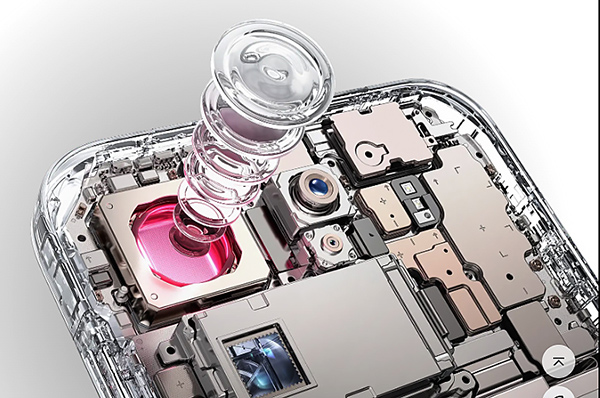
An ‘exploded’ view of the main camera, showing the individual lens elements and the position of the camera in the camera module. (Source: OPPO.)
The ultra-wide camera uses a 1/1.28-inch (12.49 mm diagonal) Sony LYT 828 sensor that has 2.1µm pixels after 4-in-1 pixel binning. This Stacked CMOS chip with Hybrid Frame-HDR technology for recording a wide dynamic range. It supports gimbal-level stabilisation for better low-light and video performance.
No details are provided about the autofocusing system, which needn’t be cutting-edge, given the angle of view of the of the lens and the size of the sensor’s photosites. OPPO’s press release only states ‘This sensor uses ground-breaking Real-Time Triple Exposure technology that captures breathtaking detail in both shadows and highlights’ suggesting multi-exposure capture.
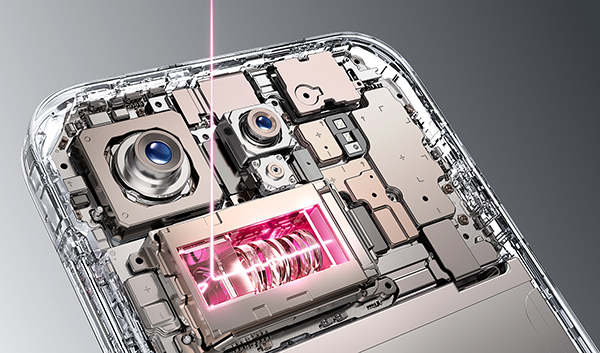
An ‘exploded’ view of the telephoto camera, showing how light is funnelled through the individual lens elements to the sensor and the position of the camera in the camera module. (Source: OPPO.)
The 70mm equivalent, ‘periscope’ telephoto camera uses a 1/1.95-inch (8.2 mm diagonal) Sony LYT600 sensor with 0.8µm pixels and supports all-pixel, multi-directional PDAF focusing and OIS. OPPO claims 200-megapixel resolution for this camera, which is reduced to the same 50-megapixel effective resolution as the other RGB cameras at 6x optical zoom, with ‘heavy’ pixel binning and/or cropping to achieve optimal noise levels at different zoom magnifications.
Complementing these three cameras in the module is OPPO’s ‘True Colour Camera’, a dedicated 8-channel, monochrome sensor with two million pixels and a computational system that divides the image into a 6×8-pixel grid and measures differences in lighting across these image zones. The resulting information from the True Colour Camera is shared across all lenses to prevent colour shifts between lenses.
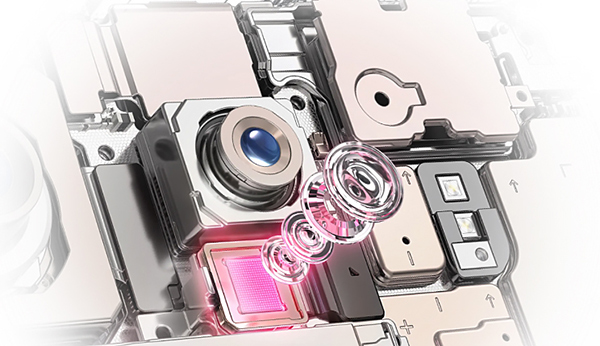
An ‘exploded’ view of the ‘True Colour Camera’. (Source: OPPO.)
The front-facing, 9-channel camera has a 1/2.74-inch (~5.7 x 4.3 mm) Sony IMX615 sensor with 50 megapixels and a pixel size of 0.8 . Encompassing a 90-degree field of view, this lens has five plastic elements (5P) and supports autofocusing.
Thanks to an efficient processing pipeline, the Find X9 series phones can record full-resolution, 50-megapixel images by default. These shots are identified by a superimposed 8K icon on the image when it is viewed in the native Photos app.
Interestingly, the cameras will also default to lower resolutions – 25 or 12 megapixels – in challenging conditions like low light levels or when the device is hot and shooting at high resolution could introduce more image noise. To manage over-heating, the device includes a vapor chamber cooling system with a large (32,052.5mm²) heat dispersion area combining a redesigned vapor chamber with high-performance thermal gel, stainless steel mesh and extensive use of graphite.

This graphic shows the structure of the vapor chamber cooling system in the Find X9 Pro. (Source: OPPO.)
Challenging conditions shouldn’t prevent you from selecting the camera’s Hasselblad Hi-Res mode when maximum resolution is required. In use we found the Find X9 Pro remained fully functional even on days above 40 degrees Celsius in Sydney’s summer heat and didn’t feel excessively warm during stills capture, although it warmed up a bit when recording video clips several minutes long.
Stabilisation
Image stabilisation is a key requirement in all hand-held imaging devices. Unfortunately, the small sizes and light weights of smartphones make it more difficult to keep them as steady while you’re recording than the systems in most ‘proper’ cameras so it’s worthwhile looking at the options available.
The stabilisation systems in all modern smartphones are based on one or more of the following processes:
- Optical image stabilisation (OIS) is a hardware solution that uses a micro-electromechanical system (MEMS) gyroscope to detect movement and adjust the lens elements in the camera system accordingly.
- Electronic image stabilisation (EIS) uses the phone’s accelerometer to detect camera shake and then aligns each frame to compensate for that movement. Mainly required for video work, it involves some degree of frame cropping.
- Hybrid image stabilisation (HIS) combines OIS and EIS, with OIS provides the essential hardware base while EIS is used for fine-tuning. The camera modules in higher-featured smartphones use 5-axis systems that move both sensor and lens components.
- Sensor-shift image stabilisation (SIS) moves the actual image sensor to stabilise the image. It is so far only used in Apple iPhones and, since sensors are usually lighter than lenses, it tends to be faster than OIS.
The main and telephoto cameras in the Find X9 Pro combine OIS and EIS to leverage the benefits of both and also use OPPO’s proprietary ‘SmartSensor’ technology, which claims to be faster, more precise and power-efficient than conventional OIS by compensating for movement on three axes, including the roll axis.
File formats
The Find X9 Pro records stills as JPEGs by default, although you can also set it to record images in HEIF format, which has the advantage of higher bit depth (10-bit vs 8-bit for JPEGs) but may not be supported in some image editors. If you choose this option, you can turn on convert HEIF photos for sharing in the Photos app’s Settings menu when you need JPEG versions.
When you select Master mode, you’re given a choice of four file formats with standard and Max options for JPEG and DNG.RAW files. Unfortunately, RAW+JPEG and RAW+HEIF aren’t supported.
The default recording format for movies is MP4 and you can choose from 720p, 1080p and 4K resolutions and frame rates of 30 fps, 60fps and 120 fps. For additional stabilisation you can tap on the camera icon (circled in red on the top toolbar in the screen grab below) and select the Ultra Steady stabilisation boost. The shaking camera icon in the top panel in the screen grab below engages this function.
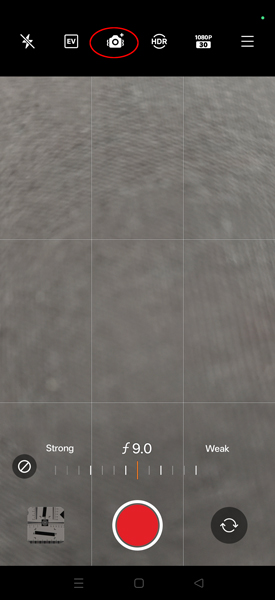
Stills can be recorded while you’re shooting a movie clip in Motion Photo mode but they will always be saved as JPEGs, even if you’ve set the HEIF format for still capture. The Find X9 Pro also offers a ‘Pro Video’ mode in the camera app where you can enable LOG recording.
Camera settings
When you open the Camera function, six options presented: Master, Video, Photo, Portrait, Hasselblad Hi-Res and More. If select the camera’s Photo mode, you’re given a choice of four main shooting modes: None (which engages automatic subject detection), Stage, Silhouette and Fireworks.
Lens focal length settings can be selected from 28mm, 35mm, 85mm and 308mm with the default main camera. The camera also provides a +/-2EV exposure compensation adjustments that works in both Photo and Movie modes.
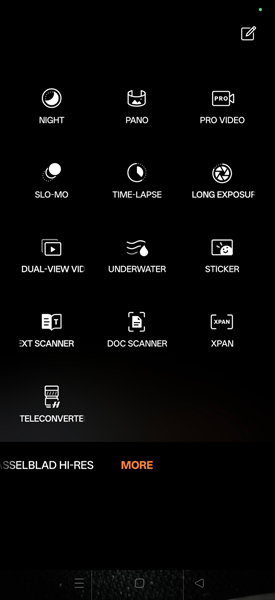
Selecting the More mode (shown above) lets you access additional settings: Night, Panorama, Pro Video, Slo-Mo, Time-Lapse, Long Exposure, Dual-view video, Underwater, Sticker, Text Scanner, Doc Scanner, XPAN and Hasselblad Teleconverter. In all these modes, the default setting is full auto shooting for both stills and video.
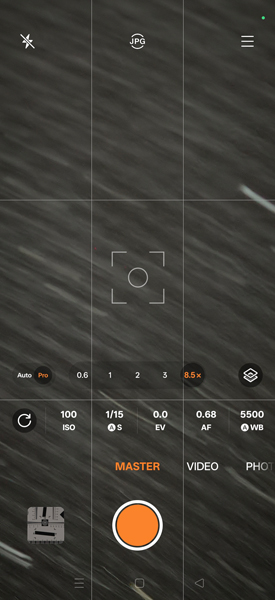
You must switch to the Pro mode, which is in the Master mode, to change ISO values (which range from 50 to 3200), shutter speeds (30 seconds to 1/8000 second) and manual focus distances (0 to 1.0 in decimal values that probably equate to fractions of a metre). White balance can be set between 2000K and 8000K and there’s a +/-150 step ‘tone’ adjustment that ranges between ‘cold’ and ‘warm’. Soft light, saturation, cyan/magenta balance, sharpness and vignette modes are also provided.
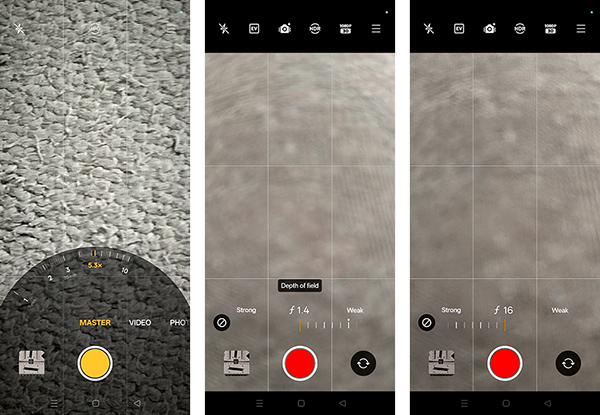
These three screen grabs show the zoom arc plus the aperture limits with the camera’s default settings. (The crossed circle to the left of the depth-of-field range is the button you press to access aperture settings.)
Aperture settings can only be adjusted when you’re setting zoom magnifications. The camera provides a pop-up arc with apertures ranging from f/1.4 to f/16 by default. Histogram, focus peaking, focus magnification and face metering are all available via a three-line sub-menu you can call up from the top right corner of the screen.
This sub-menu also displays the self-timer settings, which provide 3 and 10-second delays plus the default Off setting. Users can also choose the recording area/aspect ratio settings from 1:1, 4:3, 16:9 and Full.
Shots taken with the JPEG and RAW settings record 7.7-megapixel files, whereas shots taken with the JPEG Max and RAW Max settings yield 30.8-megapixel files – but are only available in the Master mode. These differences won’t be so important if you only want shots for online sharing; in fact, they are the more sensible option.
However, if you have any plans to print your photos – or want to archive them for future use – you should be using the ‘Max’ settings. More resolution is always the preferred option for such applications.
Computational functions
Data captured by the cameras feeds into OPPO’s LUMO Image Engine, a software processor that drives the Find X9 Pro’s extensive computational system. Through use of parallel computing, it coordinates the ISP, NPU, GPU, and CPU to work together with each component working on the task it’s best suited to for a smooth workflow.
This cuts the CPU load and power consumption by as much as 50% and improves image quality by boosting clarity and dynamic range. AI-trained models are used for denoising and demosaicing, providing improved noise reduction and greater image detail.
Find X9 smartphones include a Hasselblad Master Mode function, which supports manual control for some key imaging parameters. By default, the colour rendition is set to replicate the characteristics of the Hasselblad X2D camera but users can choose from a range of pre-set profiles or create and save their own custom settings.
Unlike earlier Find X5 series models, the Find X9 Pro doesn’t use OPPO’s proprietary
MariSilicon X Neural Processing Unit (NPU), instead relying on the powerful integrated NPUs within their main flagship chipsets (like Snapdragon 8 Gen 3) to provide similar – or even improved – computational functions. These capabilities enable real-time RAW processing and 20-bit HDR, improving image quality beyond standard RAW.
Video capabilities
All the cameras in the Find X9 Pro are capable of recording movies at 4K resolution with frame rates up to 60 fps (50 fps for PAL system users). This is extended to 4K 120fps Dolby Vision HDR video recording on the main camera and telephoto cameras, allowing users to record slow-motion footage without compromising stabilisation.
Interestingly, if you simply select the video mode in the camera menu, the default setting appears to be Full HD 1080p at 30 frames/second. This makes sense for users who like to share videos online and it’s not too difficult to change settings.
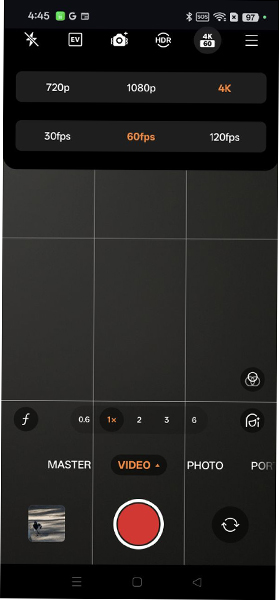
The video options are clearly laid out on the screen.
For professional users, the Find X9 Series supports LOG recording with ACES certification, providing a flat, data-rich file for professional colour grading, which integrates seamlessly into a professional workflow. The built-in LUT Preview lets users see the final colour grade in real time, while recording with the widest dynamic range.
The Find X9 Pro’s LUMO Image Engine also allows it to be the first smartphone to introduce 4K Motion Photo, one of the most popular features of regular camera. This sets the camera to capture a short video clip alongside each still image. Which, in previous smartphones has been limited to 2K or lower resolution.
It’s accessed in the Hasselblad Hi-Res mode by tapping the 4K icon at the top of the screen. The value of this feature is the extended choice it gives users when they require printable shots that preserve rapidly-changing actions. (4K frames are printable to A3 size.)
Performance
We’ve based our main assessments on shots taken in the JPEG Max and RAW Max modes because they support the highest resolution. By way of comparison, the two files below show the differences in resolution between JPEGs taken with the standard and Max modes.
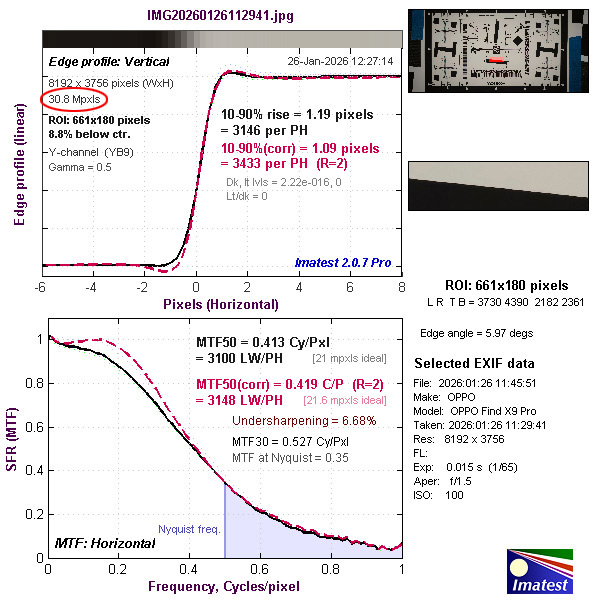
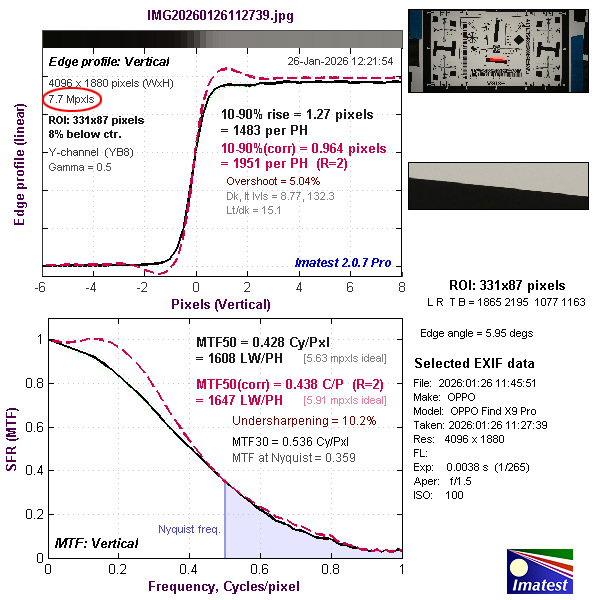
The test file on the top shows the centre-of-frame result for the JPEG Max mode, while the one below, taken at the same ISO setting, shows the default standard JPEG mode result.
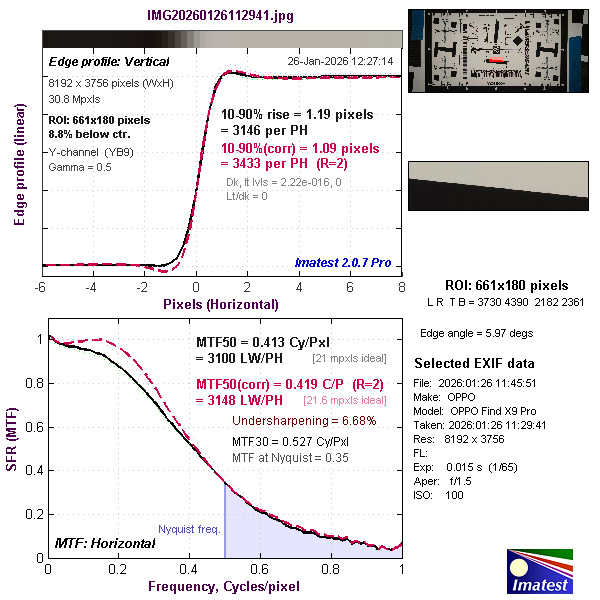
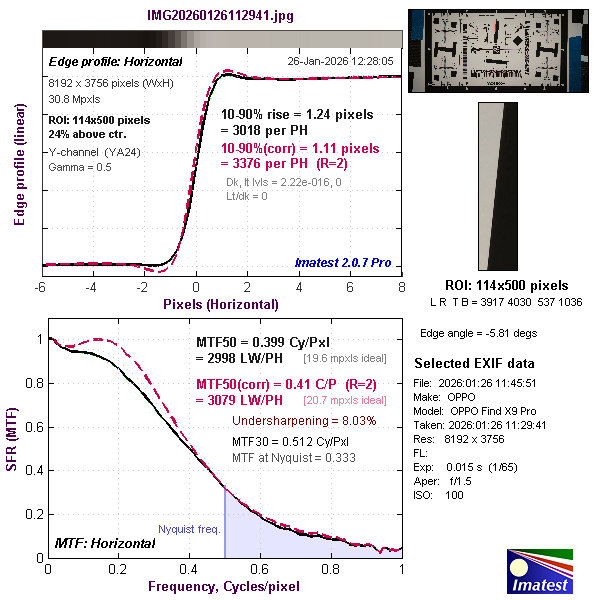
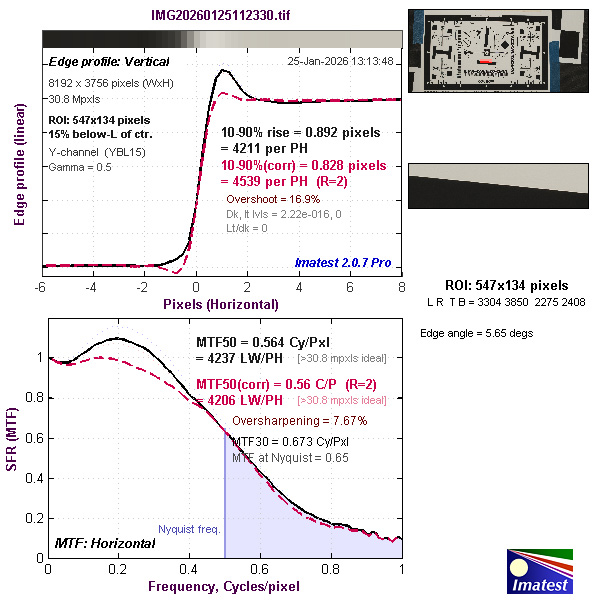
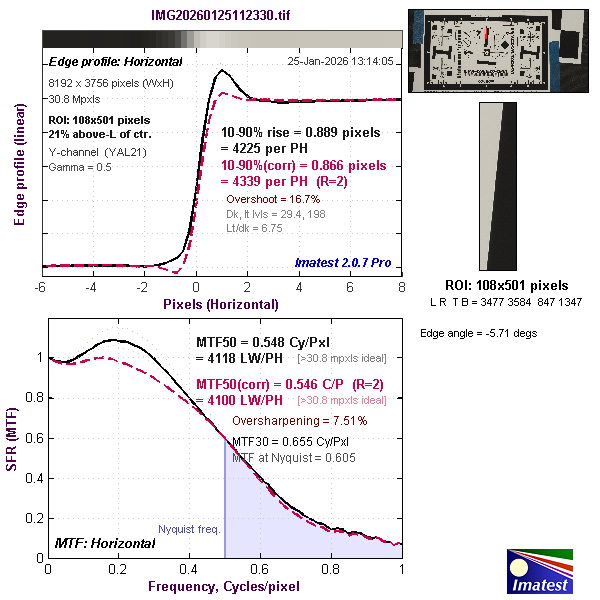
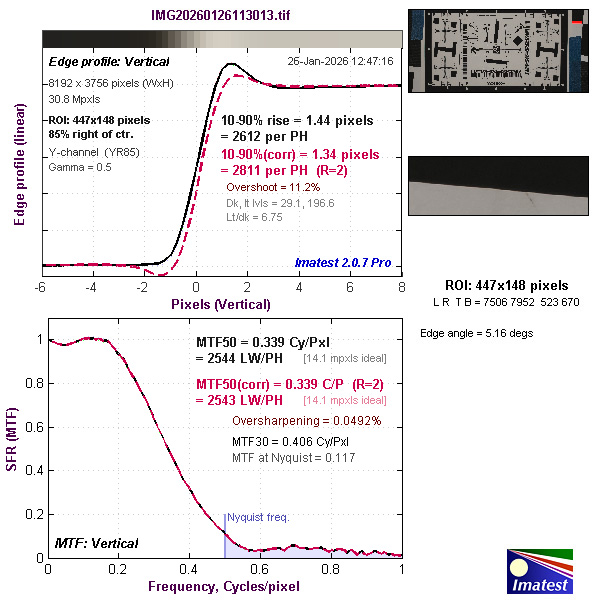
Results from our Imatest tests showed the camera arrays in the Find X9 Pro were more than capable of exceeding expectations for the sensor resolution in and around the centre of the frame, regardless of whether JPEG or RAW capture was selected and in both the standard and Max modes. Only at the periphery of the frame did the measured resolutions fall a little short – and that was to be expected.
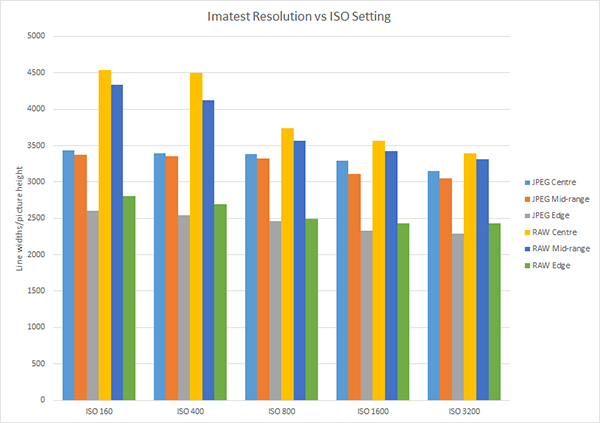
This graph shows measured resolutions at different ISO settings for the centre, middle and corner of the image frame for the selectable formats in the Master/Pro shooting mode.
Colour reproduction was also very good, with only minor shifts in reds and blues in JPEG files and in yellows and reds in DNG.RAW files. Colour saturation was also very well controlled in both file formats, although some images appeared over-processed at the longest end of the zoom range. Night shots showed slight over-sharpening but were otherwise quite impressive.
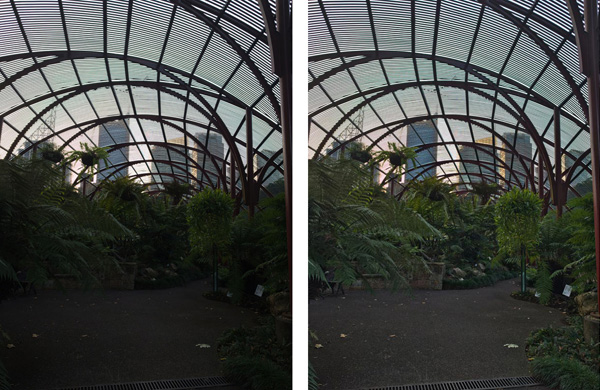
These two images show the main differences between recording JPEG files (left) and DNG.RAW files (right), regardless of whether you use the default standard or Max settings.
Video performance was also very good, with 4K clips recorded at 30 fps and 60 fps looking very sharp and colour accurate. Clips shot with the 120 fps ‘slow-motion’ setting weren’t quite as sharp but could be considered acceptable.
Slightly lower levels of sharpness were captured with the FHD (1920 x1080 pixels) resolution, except for the 120 fps setting where frames looked slightly soft. Only one frame rate – 30 fps – is available with HD (1280 x 720 pixels) resolution and clips looked slightly sharper than those recorded at 120 fps in FHD resolution, which is to be expected.
We found no evidence of rolling shutter effects and the camera module’s exposure system produced well-balanced exposures with realistic colour balances in both outdoor and indoor settings – including in a clip showing tropical fish in an indoor aquarium where the available light had a distinct purplish cast. Frame grabs are included in the Samples section below.
Zooming via the ‘pinch and ‘spread’ gestures was generally smooth and the Ultra Steady stabilisation boost kept footage somewhat more steady than we expected during all recordings. Soundtracks were nicely recorded, given the limitations of a smartphone, and similar in quality to many cameras we’ve reviewed.
The Find X9 Pro we reviewed became a little warm with extensive use while recording movies. It’s not something to be alarmed about – but should be monitored. Battery performance was outstanding; we found a single charge would last for several days of normal use.
Conclusion
Login or Register to access the full article.
SPECS
Display: 6.78-inch flat-screen Flexible AMOLED, 10-bit colour depth (1.07 billion colours), 120Hz refresh rate, 19.8:9 FHD+ (2760 × 1256 Pixels) resolution, pixel density – 460 ppi, 1800 nits natural brightness plus up to 3600 nits peak outdoor brightness, 3840Hz PMW dimming to 1 nit, 3D ultrasonic fingerprint scanner; Dolby Vision, HDR10+ and HDR Vivid certified
Touch sampling rate: Default = 120Hz; Maximum = 240Hz
Colour Gamut: Standard mode: 100% DCI-P3; Natural mode: 100% DCI-P3; Colourful mode: 100% DCI-P3
Operating system: Android 16 with pre-installed ColorOS 16 interface
Image processor: MediaTek Dimensity 9500 (3nm chipset); CPU with 8 cores, GPU – Arm@Mali Drage MC12 plus LUMO Image Engine software
RAM: 16GB LPDDR5X
Storage (ROM): 512GB UFS 4.1 (non-expandable)
Rear cameras: 3-module Hasselblad Master Camera System with wide 23mm equivalent f/1.6-aperture lens, 1/1.4-inch (9.18 x 6.88 mm) sensor with 50-megapixel resolution, 1.22µm pixels, multi-directional PDAF, OIS: ultra-wide 15mm equivalent f/2-aperture lens with 120° FOV, 1/2.75-inch (5.24 x 3.93 mm) sensor with 50 megapixels, 0.64µm pixels; 73mm equivalent f/2.6-aperture telephoto lens with 1/1.95-inch (6.5 x 4.9 mm) sensor with 200-megapixels, 0.5µm pixels, , multi-directional PDAF, OIS
Front camera: 21mm f/2.4 9-channel camera with 50 megapixels; FOV 90°; 5P lens; AF supported
Image file formats: Stills: HEIF (the default), JPEG, DNG.RAW, RAW MAX (larger, higher-quality DNG files); Video: MP4/HEVC (the default); LOG recording available in Pro Video mode
Aspect ratios: 4:3, 16:9, 1:1, Widescreen, Full
Shooting modes: Photo, Video, Portrait, Hasselblad Hi-Res, Night, Panorama, Pro Video, Slo-Mo, Time-Lapse, Long Exposure, Dual-view video, Underwater, Sticker, Text Scanner, Doc Scanner XPAN and Hasselblad Teleconverter
Video: Rear cameras support: 4K video: 120fps, 60fps, 30fps; 1080P video: 120fps, 60fps, 30fps; 720P video: 30fps; 4K SLO-MO video: 120fps; 1080P SLO-MO video: 240fps, 120fps; 720P SLO-MO video: 480fps, 240fps; 4K TIME-LAPSE: 30fps; 1080P TIME-LAPSE: 30fps; also supports Pro video shooting, video anti-shake shooting, Dual-view video shooting, HDR video shooting, video zoom shooting: Optical zoom: Up to 3x; Digital Zoom: Up to 18x
Durability: IP68/IP69 dust and water resistance, 5-star SGS drop resistance, Aerospace-grade aluminium frame, Corning Gorilla Glass Victus 2 (front and back)
Biometrics: Fingerprint and facial recognition supported
Cellular Network: SIM 2 with support for Nano-SIM card, Nano-USIM card + eSIM
Frequency Band: GSM: 850/900/1800/1900MHz; WCDMA: Band 1/2/4/5/6/8/19; LTE FDD: Band 1/2/3/4/5/7/8/12/13/17/18/19/20/25/26/28/32/66/71; LTE TDD: Band 38/39/40/41/42/48; 5G NR: n1/n2/n3/n5/n7/n8/n12/n20/n25/n26/n28/n38/n40/n41/n48/n66/n71/n75/n76/n77/n78/n79
Connectivity: Dual SIM, NFC, Wi-Fi 7 (802.11be), Wi-Fi 6 (802.11ax), Wi-Fi 5 (802.11ac), 802.11a/b/g/n, Wi-Fi 2.4GHz 2 × 2 + Wi-Fi 5GHz 2 × 2 concurrent, Wi-Fi 5GHz 160MHz, Wi-Fi 6GHz 320MHz, 2 × 2 MIMO supported; Bluetooth 6.0, Low Energy, BLE Audio
Interface ports: Type-C, USB 3.2 Gen 1; USB Type C earphone jack, 4 microphones
Location Technology: GPS (L1 + L5), GLONASS (G1), BDS (B1I + B1C + B2a + B2b), Galileo (E1 + E5a + E5b), QZSS (L1 + L5), NavIC (L5); Supports A-GNSS assisted positioning, WLAN positioning, Cellular network positioning
Power supply: 7500mAh silicon carbon battery with 80W SUPERVOOC charging and 50W wireless charging; Supports (MAX): 80W SUPERVOOCTM, 80W UFCS. Compatible with: 67W and below SUPERVOOCTM, 44W third-party UFCS, 55W PPS, 11.7W PD; Supports (Max): 50W AIRVOOC
Dimensions (wxhxd): 76.46 x 161.26 x 8.25 mm
Weight: Approx. 224 grams
Distributor: OPPO Australia
TESTS
Based on JPEG files.
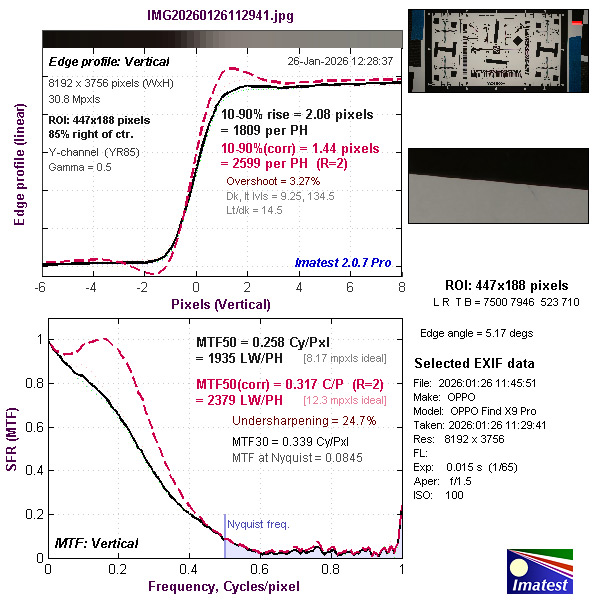
Based on DNG.RAW files converted into 16-bit TIFF format with Adobe Camera Raw.
SAMPLES

Widescreen aspect ratio; 7mm focal length, ISO 100, 1/4196 second at f/1.5.

4:3 aspect ratio; 7mm focal length, ISO 100, 1/845 second at f/1.5.
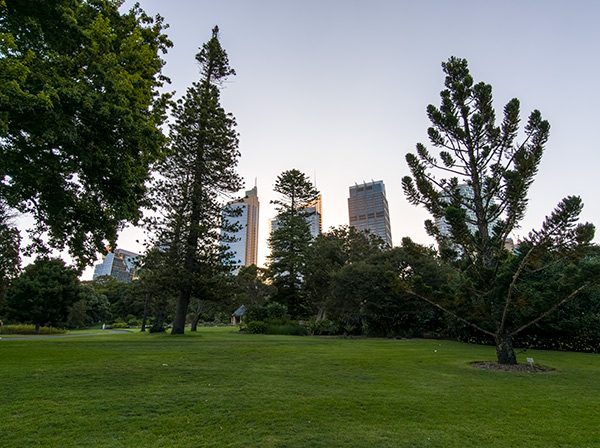
From DNG.RAW file; 4:3 aspect ratio; 2mm focal length, ISO 400, 1/200 second at f/2.

Crop from the above image magnified to 100% showing coloured fringing.

From DNG.RAW file; 4:3 aspect ratio; 17mm focal length, ISO 400, 1/20 second at f/2.1.


Backlit close-up with telephoto zoom; 17mm focal length, ISO 320, 1/100 second at f/2.1.

Close-up in macro mode; 17mm focal length, ISO 500, 1/71 second at f/2.1.

From DNG.RAW file; 4:3 aspect ratio; 7mm focal length, ISO 400, 1/100 second at f/1.5.

4:3 aspect ratio; 17mm focal length, ISO 400, 1/40 second at f/2.1.

Indoor shot; 4:3 aspect ratio; 7mm focal length, ISO 1000, 1/120 second at f/1.5.

Indoor shot; 4:3 aspect ratio; 17mm focal length, ISO 640, 1/20 second at f/2.1.

Indoor shot; 16:9 aspect ratio; 7mm focal length, ISO 640, 1/152 second at f/1.5.

Indoor shot; full screen aspect ratio; 17mm focal length, ISO 640, 1/35 second at f/2.1.

Full screen aspect ratio; 7mm focal length, ISO 64, 1/200 second at f/1.5.

Full screen aspect ratio at full telephoto zoom; 17mm focal length, ISO 100, 1/100 second at f/2.1.

Panorama mode; no EXIF data recorded.

16:9 aspect ratio; 7mm focal length, ISO 5000, 1/8 second at f/1.5.

16:9 aspect ratio; 17mm focal length, ISO 12800, 1/5 second at f/2.1.

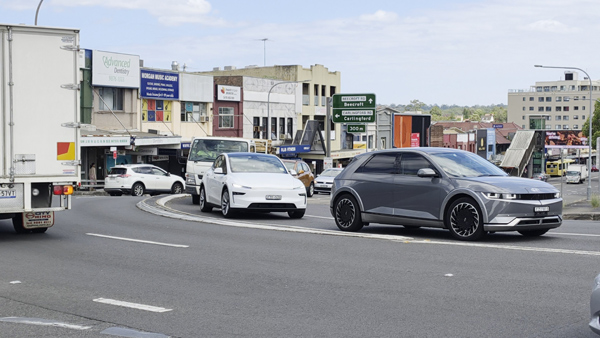
Still frame from MP4 video clip recorded at 4K 60p.
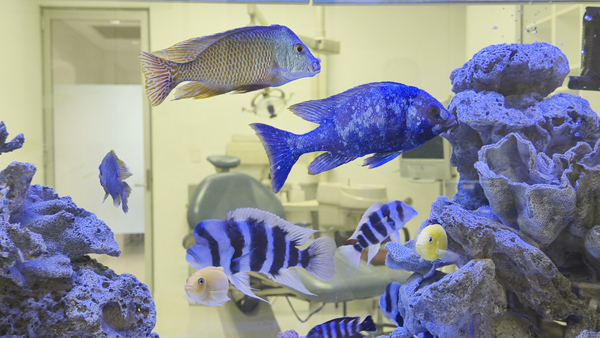
Indoor recording with artificial lighting that has a purple cast; 4K 60p
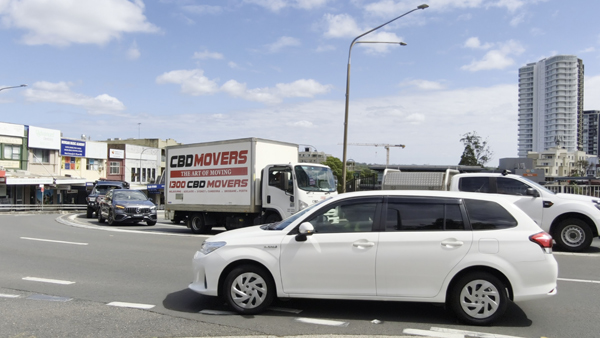
Still frame from MP4 video clip recorded at 4K 30P.
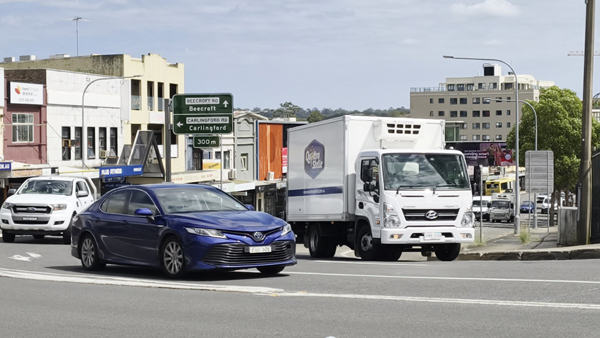
Still frame from MP4 video clip recorded at 4K 120p.
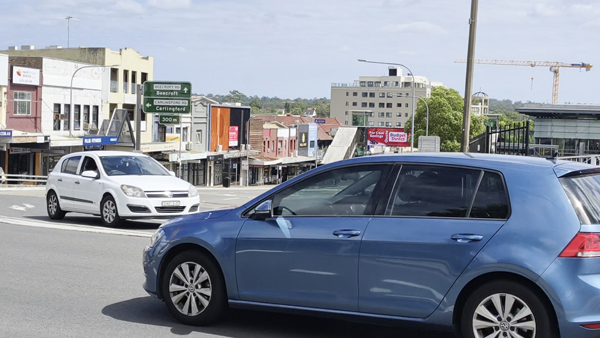
Still frame from MP4 video clip recorded at FHD 60p.
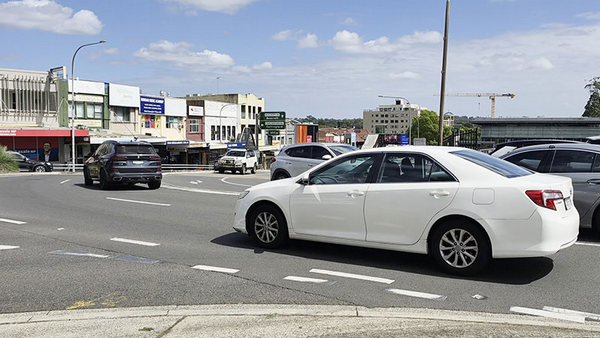
Still frame from MP4 video clip recorded at FHD 30p.

Still frame from MP4 video clip recorded indoors at FHD 30p.

Still frame from MP4 video clip recorded at FHD 30p.
Some additional image samples can be found with our review of the Hasselblad Teleconverter Kit for OPPO Find X9 Pro.
Rating
RRP: AU$2,299
- Build: 9.0
- Ease of use: 8.8
- Autofocusing: 8.9
- Image quality: 9.0
- Video quality: 9.0