Top-flight performance from a versatile film and flatbed scanner.


Inspiring ways to improve your photos
Inspiring ways to improve your photos
Photo Review Reviews section
Top-flight performance from a versatile film and flatbed scanner.

Epson’s Perfection 4490 Photo scanner has many of the features of the Perfection 4990 Photo model but a $300 lower price tag. For photographers, the 4490 has a moving carriage transparency unit (TPU) plus holders for 35mm and medium format films. It also comes with Digital ICE and Digital ICE Lite dust- and scratch-removal technology, the first time these facilities are offered in a mid-priced scanner. (Digital ICE is accessible in the Home and Professional modes, while Digital ICE Lite is Professional mode only.)
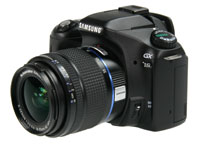
A competitively priced DSLR with all of the controls needed by amateur photographers.Samsung’s first DSLR camera, the GX-1S, reflects its mixed ancestry in a body that appears almost identical to Pentax *ist DS2, and has remarkably similar specifications. Although compatible with most Pentax KAF mount lenses, the GX-1S is being supplied with a Schneider Kreuznach D-Xenon 18-55mm f/3.5-5.6 lens, which has been specially developed for the new camera. Its light weight (225 g) is a comfortable match for the camera body, but rather a snug fit on the camera body. It comes with a clip-on lens hood.

Straightforward calibration of CRT or LCD monitors for colour-managed output.

[ia] Although not the most compact DSLR available, the Pentax *ist DS is the smallest and lightest in the 6.1-megapixel category and keenly priced for its category. Sporting a tough, stainless-steel chassis and sophisticated electronics, the *ist DS combines the controls photographers want with plenty of user-friendly features, making it a good choice for any photographer who wants an affordable, high-performing camera. It will be especially attractive to those with Pentax K, KA, KAF, and KAF2 lenses, most of which can be used with the *ist DS body.

Smaller and lighter than its main competitors, the Pentax *istD features the same 6.1-megapixel CCD as the Nikon D70 and Konica Minolta Dynax 7D. Features include a pop-up flash with five selectable modes but no flash output adjustment (one of the *ist D’s few major omissions). A hot-shoe is provided for optional external flash units. The viewfinder is large, bright and informative and the 1.8-inch LCD monitor is backlit for improved viewing. Focusing is fast and accurate with most subject types and focus area selection is provided, with 11 selectable points. Over- and under-exposure warnings are also provided in manual mode. These warnings are duplicated on the top LCD panel as blinking shutter speed and aperture displays.

A high-performance Four Thirds system DSLR with SSWF dust reduction and live viewing plus an articulated LCD monitor.Panasonic’s second DSLR camera, the 10.0-megapixel Lumix DMC-L10 is far more conventional-looking than its predecessor. It’s also lighter and provides some of the features that have made the Lumix name popular with digicam buyers, such as an LCD monitor that can rotate through 270 degrees, an Intelligent ISO setting, a range of Scene pre-sets and a straightforward user interface. A dedicated Function button provides quick access to key camera settings.

The first ‘consumer’ DSLR for the Four Thirds camera format.
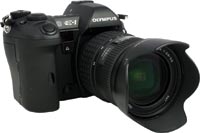
Notable performance aspects of the E-1 were its focusing speed and accuracy and the spot meter’s accuracy was equally impressive. The white balance control performed well under a variety of lighting conditions. Image quality in bright lighting was very good and the test lens delivered full edge-to-edge sharpness but noise was obvious at high ISO settings.

With no higher-resolution sensor available, Nikon has opted to improve the features and functionality of its popular D70 model. Fortunately, until the next generation of ‘pro-sumer’ DSLR cameras arrives, the new D70s model will make many potential buyers very happy. For starters, for the $1999 price tag you now get a high-quality AF-S Nikkor 18-70mm lens as well as the improved camera body.
 Latest news, reviews, tips, and new ways to improve and inspire your photography.








Ads can be a pain, but they are our only way to maintain the server. Please deactive Ads blocker to read the content. Your co-operation is highly appreciated and we hope our service can be worth it.
