

In summary
Tamron’s 35-100mm f/2.8 Di III VXD is a versatile everyday zoom lens that covers the most popular portrait focal lengths and is ideal for travellers with Nikon or Sony full-frame mirrorless cameras.
Full review
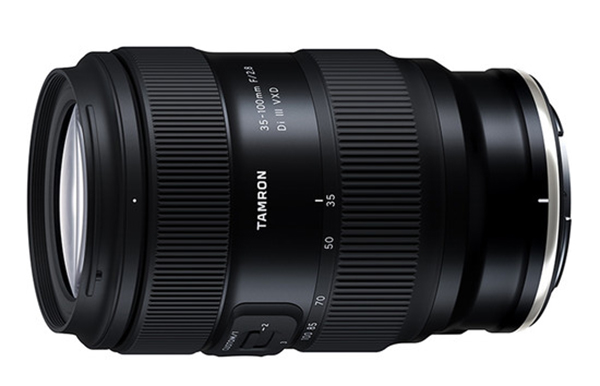
Announced on 19 February and arriving in stores on 26 March, Tamron’s latest full-frame zoom lens for Sony E-mount and Nikon Z-mount cameras is small and light enough to be a serious contender for the ideal travel lens. Weighing only 565 grams and just 119 mm long, the Sony version is slightly lighter than the Nikon Z-mount version but both provide easy-to-carry all-in-one zoom choices for weight-conscious owners of full-frame cameras. The constant f/2.8 maximum aperture and weather-resistant construction are added bonuses that reinforce the lens’s versatility for shooting almost anywhere in most kinds of weather.
Angled view of the new Tamron 35-100mm f/2.8 Di III VXD lens without lens caps and the supplied lens hood. (Source: Tamron.)
The optical design of this lens consists of 15 elements in 13 groups and includes three glass-moulded aspheric elements (one of them also a low-dispersion aspheric element), one additional low-dispersion element and an extra low-dispersion element, as shown in the optical diagram below. BBAR-G2 (Broad-Band Anti-Reflection Generation 2) coating has been applied to minimise ghosting and flare and the front element is fluorine-coated to repel moisture and oils and make it easy to keep clean.
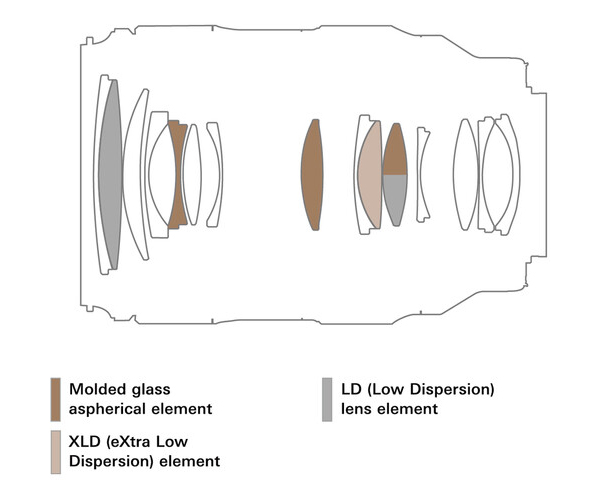
The optical design of the Tamron 35-100mm f/2.8 Di III VXD lens, showing the positions of the internal elements. (Source: Tamron.)
Tamron has equipped this lens with its fastest, most precise VXD (Voice-coil eXtreme-torque Drive) linear motor focus mechanism, which also operates almost silently, making it ideal for videography. Its minimum focus of 22 cm at the 35mm focal length and 65 cm at 100mm supports some close-up work and provides enough magnification for the lens to be used for capturing close-ups of larger flowers, leaves and jewellery, where the lens speed will allow good depth-of-field control.
Like many Tamron lenses, the 35-100mm f/2.8 Di III VXD accepts 67 mm front-mounted filters and is compatible with the Tamron Lens Utility, the dedicated application for installing firmware updates and configuring key functions in the lens (which vary with each lens and mount). This app is available for both mobile devices (iOS and Android) and desktop computers.
Who’s it For?
Developed to address and increasing demand for more compact full-frame lenses, the Tamron 35-100mm f/2.8 Di III VXD lens puts some focus upon popular portrait focal lengths, with settings for 35mm, 50mm, 85mm and 100mm marked on its barrel. This gives users flexibility to shoot portraits ranging from group shots and environmental portraits through to head-and-shoulders portraits.
Landscape photographers for whom the 35mm wide angle is too restricting could supplement this lens with a lightweight prime lens in the 18-24mm range. All the main camera manufacturers have suitable offerings and Tamron has 20mm and 24mm f/2.8 lenses that could fill the bill.
The 35-100mm zoom range meets most of the requirements for use as a walk-around lens for travel snapshots and street photography, even though it doesn’t cover a particularly wide angle-of-view. Its natural-looking perspective works well for landscape and architectural shots and is good for product photography, given the depth-of-field control allowed by the constant f/2.8 maximum aperture.
The Sony version of the lens supports the following camera functions: Fast Hybrid AF, Eye AF, Direct Manual Focus, AF Assist and In-camera Lens Correction. The Nikon Z-mount version includes Hybrid AF, Eye AF, M/A Mode and manual over-ride for AF as well as In-camera Lens Correction.
Build and Ergonomics
Although constructed mainly from industrial plastic, the Tamron 35-100mm lens’s build quality is up to Tamron’s normal high standards and well above average for a consumer-level lens. While its zoom range may not be universally appealing, we found it surprisingly versatile everyday use, including street and portrait photography. The E-mount lens is a little lighter and shorter than the Z-mount version but both feature dust- and moisture-resistance. Our review sample felt comfortable in the hands and the adjustment rings moved smoothly with no unwanted slack.
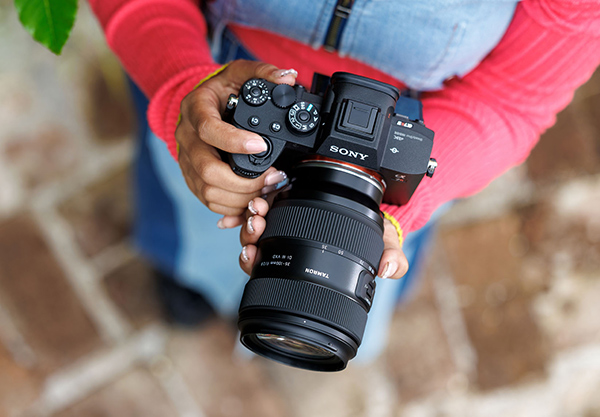
This illustration shows how well the Tamron 35-100mm f/2.8 lens fits on a Sony α7 model camera body. (Source: Tamron.)
Tamron’s full time manual focus override worked well for making fine adjustments when needed. This lens has no zoom lock but we found no tendency for the barrel to extend inconveniently when it was carried pointing downwards.
The inner barrel extends just under 20 mm when it is zoomed in to the 100mm position. The front element has a diameter of approximately 46 mm and is surrounded by a threaded filter ring that accepts the 67 mm diameter filters that have become a de-facto standard for Tamron’s regular lenses.
Its outer surface has a bayonet fitting for the supplied, petal-shaped lens hood, which is made from solid black plastic and has a ribbed inner surface to suppress reflections. The hood reverses to make the lens compact for storage and transport.
The focusing ring is located at the end of the outer barrel. It’s 20 mm wide and almost entirely clad in narrow, rubberised ridging. This ring turns through 360 degrees when power is off as focusing is driven from the camera.
Behind the focusing ring the outer barrel dips slightly inwards to meet a flat section of the barrel that is 23 mm wide and carries the branding information for the lens. A Custom slider switch around the left-hand side of the barrel has three settings that users can program for different functions, depending on what mode you have selected, using the Tamron Lens Utility app. Beside the slider switch is a selector button.
Options include a focus limiter, A-B focus shifting, setting the rotational direction of the focusing ring, changing the ring function between aperture and focus to provide more precise control in aperture-priority mode and setting the MF/AF response. A USB-C port is embedded in the barrel just in front of the lens mount so you can link the lens to your computer for this purpose.
The trailing edge of this band carries the white index mark for the zoom ring, which is located just behind it. It is 28 mm wide with a band of focal length markings around its leading end with setting points for 35mm, 50mm and 70mm. 85mm and 100mm positions. Most of its surface covered by rubber-like ridging to provide a secure grip. The ring turns smoothly with no trace of slackness.
The barrel slopes gently inwards for 5 mm and then downwards for 10 mm to meet the 10 mm wide straight band that ends in the lens mount. The USB-C port is located around the left-hand side of the barrel where the sloping section meets the straight section.
The unridged parts of the outer barrel have a smooth, low-gloss surface that has been treated to resist scratching and fingerprints. The supplied lens caps fit securely to each end of the barrel, while the lens hood can be reversed over the front of the barrel for transport and storage.
Performance
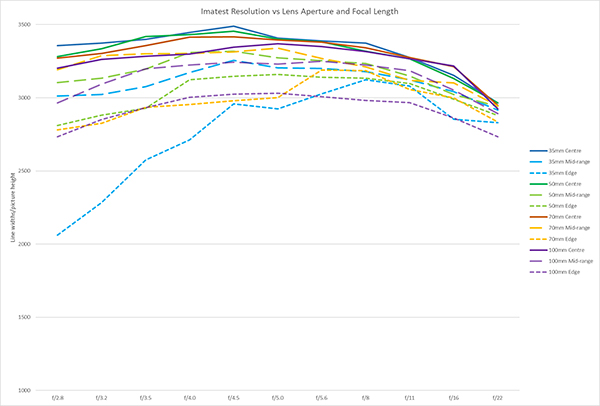
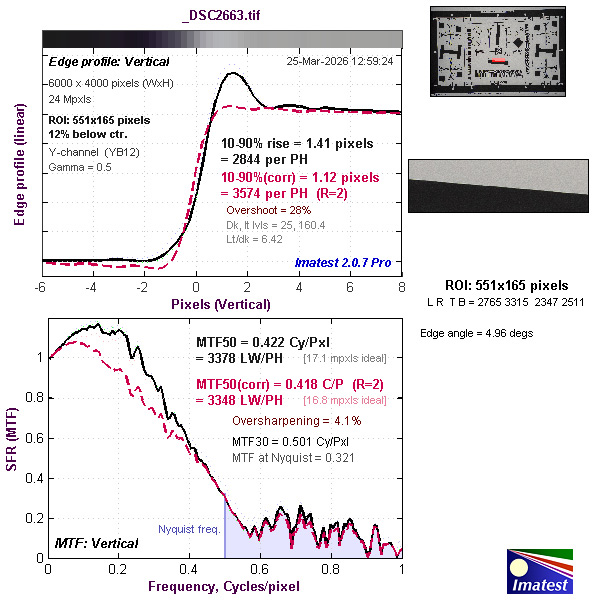
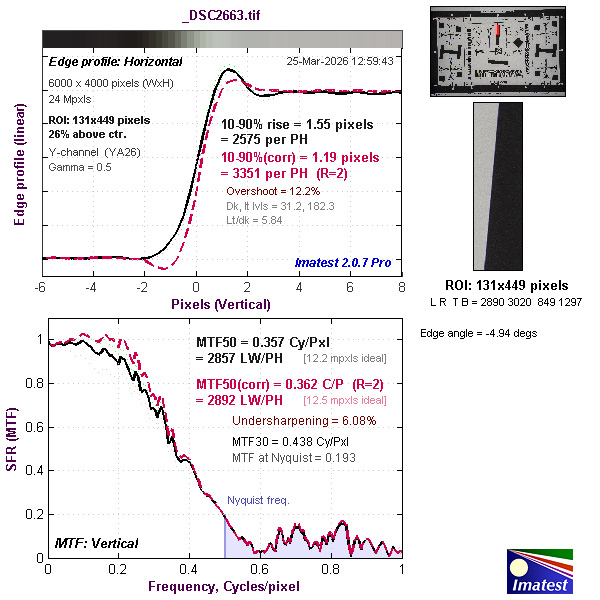
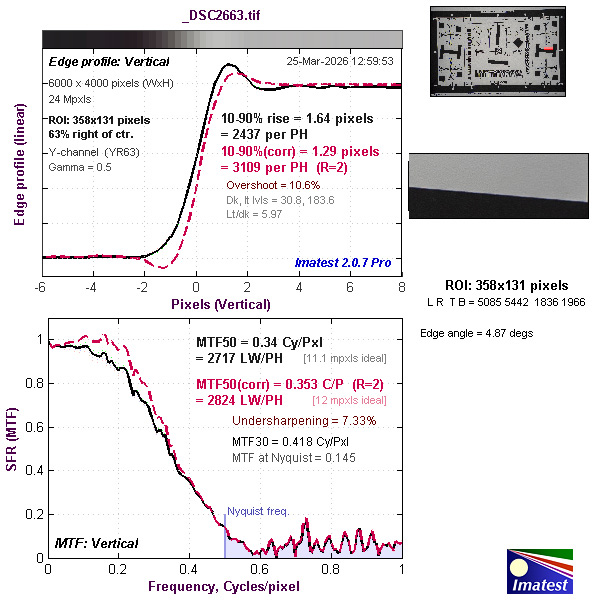
Our Imatest tests yielded some impressive results, showing the review lens to be capable of exceeding expectations for the 24-megapixel sensor on the Sony α7 II camera across a wide range of focal lengths with measurements taken in the centre of the frame. Our measurements also showed resolution declined a little across all focal lengths mid-way between the centre and the edge of the frame with some softening occurring towards the edges of the frame, generally at wide aperture settings.
Diffraction began to take effect from about f/5.6 on, although resolution remained at a usable level right through to f/22. The graph below shows the results of our tests.
We disabled all internal corrections for lens aberrations before taking our test shots to check for chromatic aberration, vignetting and distortion and found the Tamron lens suffered from all three to at least some degree. Vignetting was obvious at the widest aperture settings for all focal lengths but reduced as the lens was stopped down.
In contrast, rectilinear distortion was relatively minor, ranging from barely-detectable barrel distortion at 35mm through to obvious pincushioning from 50mm on. Both vignetting and distortion can be corrected with the in-camera processing or post-capture with the tools in most editing software.
We found some coloured fringing along high-contrast edges near the periphery of frames taken in bright conditions. But, again, that can be corrected in-camera as you shoot.
We found occasional very slight flaring with a few coloured artefacts at all focal lengths when taking our sunstar shots with the sun inside the frame, along with a few coloured flare artefacts, which some people may find desirable at times. Fortunately, that was the only time we encountered them. Sharp 18-pointed sunstars were possible at f/22 with all focal length settings, with very slight softening of edges at the longer focal lengths.
Tamron lenses usually focus well on Sony’s cameras, probably becauase Sony owns a stake in Tamron. This lens was no exception. We found it provided a good balance between focusing speed and precision although, when shooting close-ups with the aperture wide open, the focus sometimes needed a bit of manual help to hit the desired spot. Stopping down to f/4 resolved most of these issues.
Video AF was a bit more consistent and we found focus pulls to be fast and smooth and subject tracking quick to identify, lock onto and track moving subjects. Although the lens isn’t parfocal, focus breathing was effectively negligible.
Bokeh was a bit of a mixed bag and your opinion will depend upon how you use the lens and the kind of bokeh that appeals to you. With evenly-lit backgrounds, the review lens delivered very attractive results at wide aperture settings producing smooth tonal transitions and even blurring.
However, outlining was common in situations where there were bright highlights in the backgrounds, and highlights towards the edges of the frame became oval in shape. We found examples of very slight ‘onion-skin’ bokeh in some shots.
Conclusion
Login or Register to access the full article.
SPECS
Picture angle: 63 degrees 26 minutes to 24 degrees 25 minutes
Minimum aperture: f/22
Lens construction: 15 elements in 13 groups (including one XLD (eXtra Low Dispersion), two LD (Low Dispersion), and three GM (Glass Moulded Aspherical) elements) plus BBAR-G2 (Broad-Band Anti-Reflection Generation 2) coating plus fluorine coating on external elements
Lens mounts: Sony E and Nikon Z
Diaphragm Blades: 9 (rounded aperture)
Weather resistance: Moisture-resistant construction
Focus drive: VXD (Voice-coil eXtreme-torque Drive) linear motor
Stabilisation: No (relies on IBIS in camera body)
Minimum focus: 22 cm at 35mm; 65 cm at 100mm
Maximum magnification: 1:3.9 at 100mm; 1:1.9 at 35mm
Filter size: 67 mm
Dimensions (Diameter x L): 80.6 x 119.2 mm
Weight: 565 grams
Standard Accessories: Front and rear caps, petal-shaped lens hood
Distributor: Blonde Robot. Pty Ltd; www.tamron.com.au
TESTS
Based on JPEG files recorded with the Sony α7 II camera.
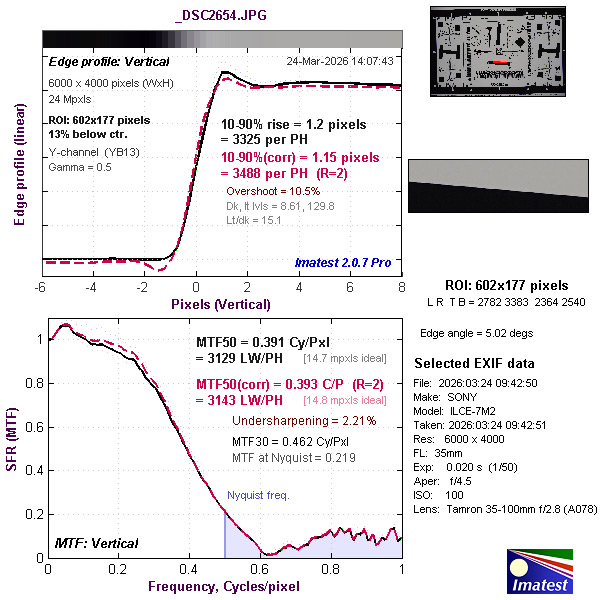
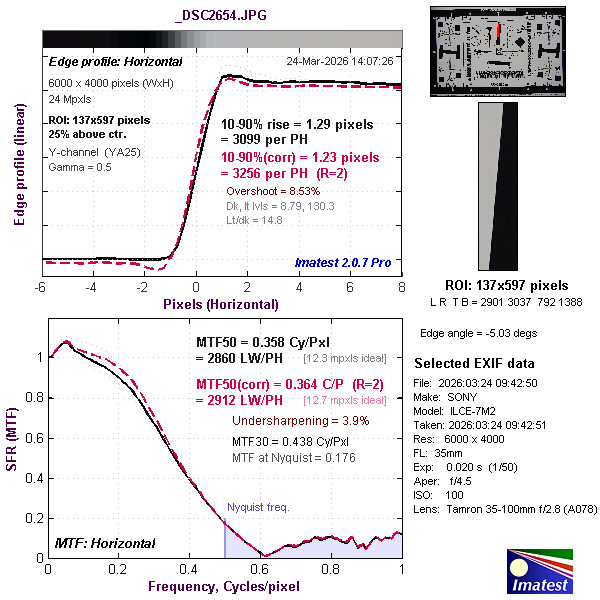
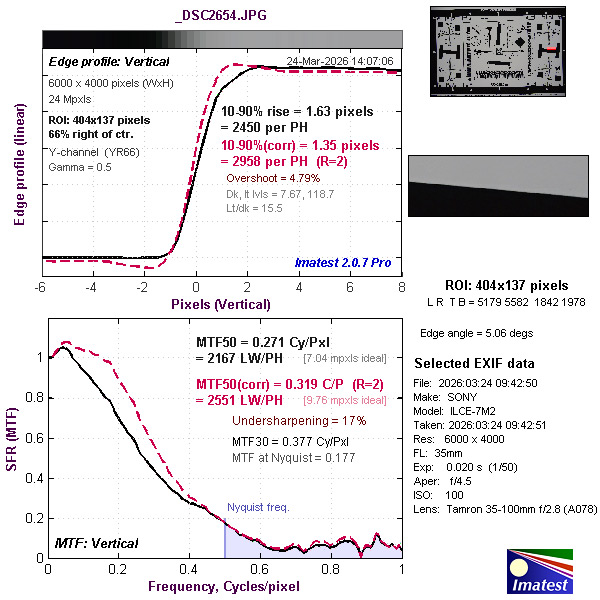
Based on ARW.RAW files recorded simultaneously and converted into 16-bit TIFF format with Adobe Camera Raw.
SAMPLES

Vignetting at 35mm f/2.8.

Vignetting at 50mm f/2.8.

Vignetting at 70mm f/2.8.

Vignetting at 85mm f/2.8.

Vignetting at 100mm f/2.8.

Rectilinear distortion at 35mm.

Rectilinear distortion at 50mm.

Rectilinear distortion at 70mm.

Rectilinear distortion at 100mm.
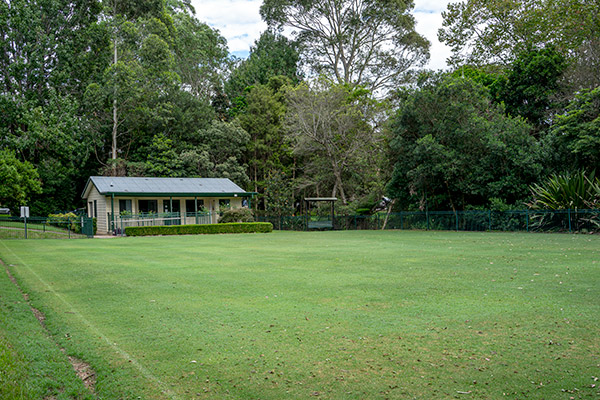
35mm focal length, ISO 100, 1/60 second at f/8.
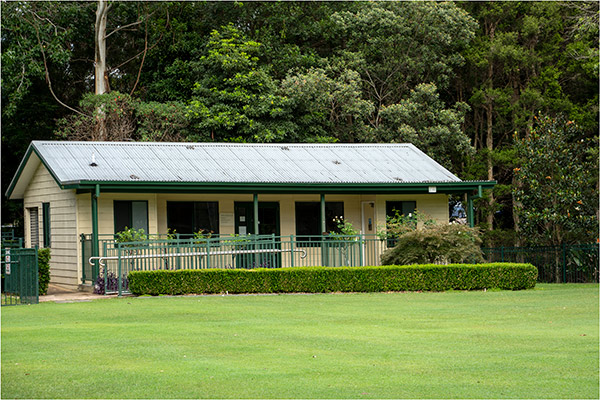
100mm focal length, ISO 100, 1/80 second at f/8.

100mm focal length, ISO 100, 1/125 second at f/2.8.

Crop from the above image magnified to 100% showing detail resolution and shallow depth of focus.

Close-up at 35mm focal length, ISO 100, 1/2000 second at f/2.8.

Close-up at 50mm focal length, ISO 100, 1/640 second at f/4.5.

Close-up at 100mm focal length, ISO 100, 1/1250 second at f/2.8.
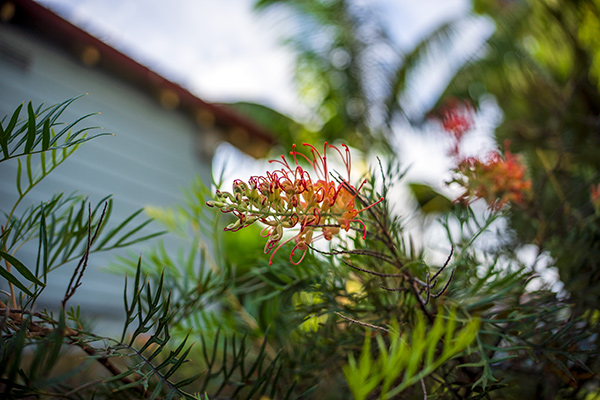
Bokeh in evenly-lit close-up at 35mm, ISO 100, 1/1000 second at f/2.8.
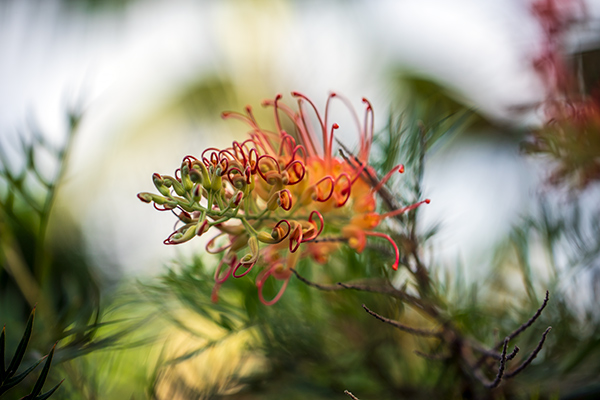
Smoother bokeh in the same subject photographed at 100mm, ISO 100, 1/400 second at f/2.8.
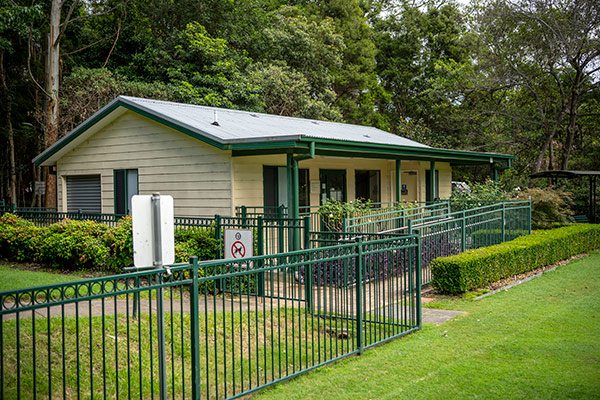
38mm focal length, ISO 100, 1/400 second at f/2.8. The focus was on the gate to the building.
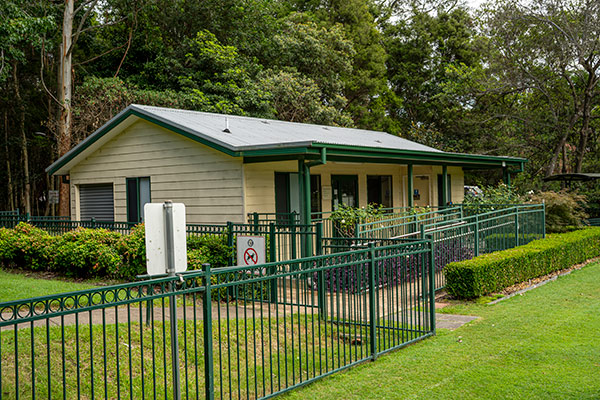
38mm focal length, ISO 100, 1/125 second at f/5.6 with the same focus.
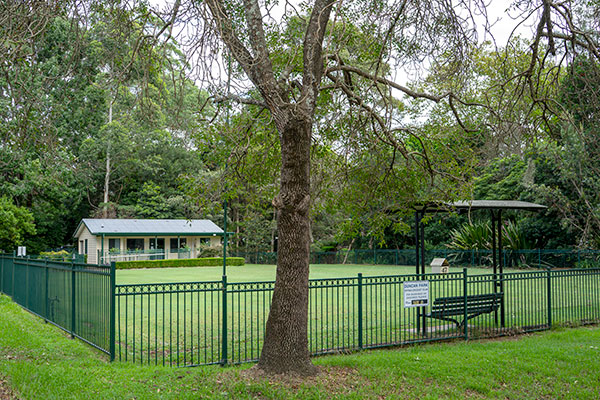
36mm focal length, ISO 100, 1/50 second at f/6.3.

Crop from the above image at 100% magnification showing coloured fringing.
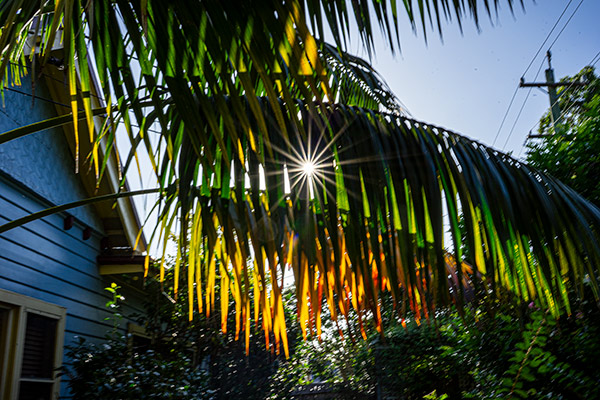
Sunstar at 35mm, ISO 100, 1/30 second at f/22.

Sunstar at 50mm, ISO 100, 1/100 second at f/22.
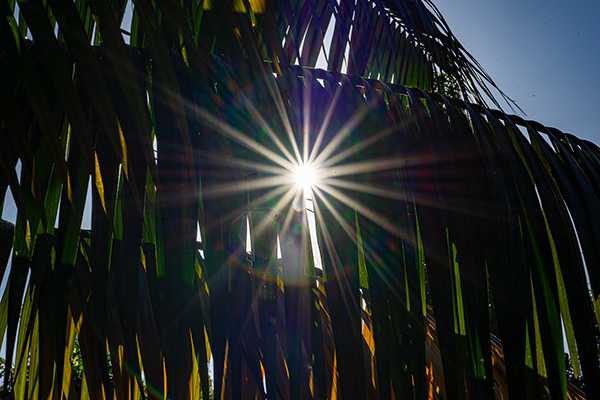
Sunstar at 70mm, ISO 100, 1/200 second at f/22.

Sunstar at 100mm, ISO 100, 1/25 second at f/22.

100mm focal length, ISO 100, 1/125 second at f/4.5.

100mm focal length, ISO 100, 1/160 second at f/7.1.
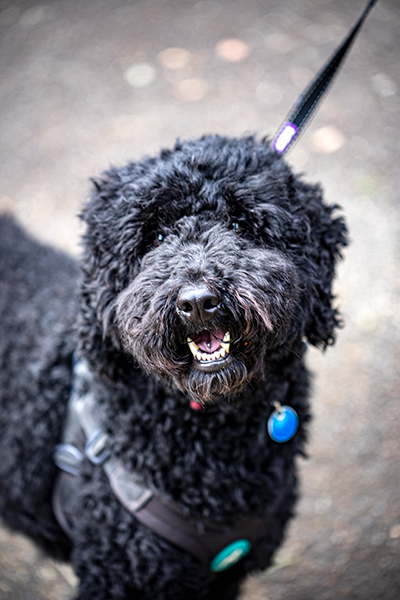
Portrait shot at 100mm focal length, ISO 100, 1/100 second at f/2.8.

Portrait shot at 100mm focal length, ISO 100, 1/200 second at f/8.

100mm focal length, ISO 100, 1/160 second at f/5.

42mm focal length, ISO 200, 1/60 second at f/5.6.

100mm focal length, ISO 1250, 1/100 second at f/2.8.

100mm focal length, ISO 800, 1/200 second at f/4.5.

70mm focal length, ISO 400, 1/250 second at f/7.1.

100mm focal length, ISO 200, 1/200 second at f/5.

36mm focal length, ISO 100, 1/100 second at f/5.6.

35mm focal length, ISO 100, 1/100 second at f/5.6.
Rating
RRP: AU$1699
- Build: 9.0
- Handling: 9.0
- Image quality: 9.0
- Autofocusing: 8.9
- Versatility: 8.9
BUY